Dear Friends,
This missive heralds the commencement of my revived enterprise of making English Arts & Crafts inspired items for men, women, children and the home. Please visit us on Pinterest and on Facebook and look for us on Etsy !!
09 July 2014


09 December 2013
The Artisan's Way
There has been a lot of talk lately about Fair Trade commodities in emerging market countries; coffee, chocolate, handmade crafts. While it is estimable to grant a living wage to those in emerging markets, I would suggest that we grant the same courtesy to artisans here in the US as well; namely, myself and every other artisan I know.
According to the Fair Wage Guide, the fair wage per hour in US dollars for artisans is $10.75, based on the Canadian calculation, as the US isn't actually on the list. This number is almost identical to the San Francisco minimum wage of $10.74, a 'large' number because it is expensive to live here. (I would in fact venture to say that no one who does not live in community cannot survive on it in or around San Francisco.) However, according to Wealth Artisan, this number is also close to the actual income of one who earns $20 per hour, or the salaried equivalent, once transportation, commute time, food and taxes are taken out of the equation. In other words, the actual earning power of the salary. If one lives in a small community outside of metropolitan areas and does not commute, that $10.75 might actually approach a living wage, so long as one figures in taxes and business license fees.
Based on this, if I make one of my stunning Brother Rabbit garments for a lady, which takes about 20 hours, the cost, without profit margin or cost of materials or shipping, works out to $215. This might seem high to a public used to dirt-cheap togs from Target or even Macy's, but it is actually in line with the 1915 price of such a dress, according to so prosaic a vendor as Sears, Roebuck & Co., basing it on one of their median-priced ($10) dresses - which would cost $231.23 in today's money. This is Sears, whose items were made in the US, at a moderate profit margin. (What they lost in per-item profit, they made up for in volume of sales).
When I go to department stores, even 'expensive' ones such as Bloomingdale's, Nordstrom's or Saks, I always look at the construction of garments (between the lining and the garment) and find that they are made ... just like things at Target, with serged seams and other cheap 'finishings' - with slightly better fabrics, at about 300 times the price. And they are made in... China. 'You get what you pay for' is not true anymore.
Except from artisans.
A hand-made item from an artisan, be it clothing, jewellery, furniture, decorative arts, pottery, wine or bread, represents years, often decades, of study, training, and countless hours of highly skilled labour. This is not something knocked together in a sweatshop by a low-paid pieceworker. This is an item that was designed, constructed and finished by the person standing in front of you, with imagination, skill and loving time. (If it is not a highly skilled item, that is another matter.) You are paying for that craftsmanship, knowing that the item will last a lifetime, and will not break on the first use, fall apart in the wash, or have parts that fail. These items, as Morris wrote, are designed to be beautiful and useful, and to last.
That is what you are paying for. Quality.
It is unfair in the extreme to expect such quality at sweatshop prices.
(It is also unfair to pay quality prices for sweatshop-grade goods).
So patronising your local artisan becomes a choice: Do you want something fine and beautiful made in your own community which will last a lifetime and which you will only have to buy once, or cheap gimcrack that will not last a year or two and requires endless re-purchase, meanwhile supporting slave labour in far foreign fields?
Thank you for reading.
According to the Fair Wage Guide, the fair wage per hour in US dollars for artisans is $10.75, based on the Canadian calculation, as the US isn't actually on the list. This number is almost identical to the San Francisco minimum wage of $10.74, a 'large' number because it is expensive to live here. (I would in fact venture to say that no one who does not live in community cannot survive on it in or around San Francisco.) However, according to Wealth Artisan, this number is also close to the actual income of one who earns $20 per hour, or the salaried equivalent, once transportation, commute time, food and taxes are taken out of the equation. In other words, the actual earning power of the salary. If one lives in a small community outside of metropolitan areas and does not commute, that $10.75 might actually approach a living wage, so long as one figures in taxes and business license fees.
Based on this, if I make one of my stunning Brother Rabbit garments for a lady, which takes about 20 hours, the cost, without profit margin or cost of materials or shipping, works out to $215. This might seem high to a public used to dirt-cheap togs from Target or even Macy's, but it is actually in line with the 1915 price of such a dress, according to so prosaic a vendor as Sears, Roebuck & Co., basing it on one of their median-priced ($10) dresses - which would cost $231.23 in today's money. This is Sears, whose items were made in the US, at a moderate profit margin. (What they lost in per-item profit, they made up for in volume of sales).
When I go to department stores, even 'expensive' ones such as Bloomingdale's, Nordstrom's or Saks, I always look at the construction of garments (between the lining and the garment) and find that they are made ... just like things at Target, with serged seams and other cheap 'finishings' - with slightly better fabrics, at about 300 times the price. And they are made in... China. 'You get what you pay for' is not true anymore.
Except from artisans.
A hand-made item from an artisan, be it clothing, jewellery, furniture, decorative arts, pottery, wine or bread, represents years, often decades, of study, training, and countless hours of highly skilled labour. This is not something knocked together in a sweatshop by a low-paid pieceworker. This is an item that was designed, constructed and finished by the person standing in front of you, with imagination, skill and loving time. (If it is not a highly skilled item, that is another matter.) You are paying for that craftsmanship, knowing that the item will last a lifetime, and will not break on the first use, fall apart in the wash, or have parts that fail. These items, as Morris wrote, are designed to be beautiful and useful, and to last.
That is what you are paying for. Quality.
It is unfair in the extreme to expect such quality at sweatshop prices.
(It is also unfair to pay quality prices for sweatshop-grade goods).
So patronising your local artisan becomes a choice: Do you want something fine and beautiful made in your own community which will last a lifetime and which you will only have to buy once, or cheap gimcrack that will not last a year or two and requires endless re-purchase, meanwhile supporting slave labour in far foreign fields?
Thank you for reading.
28 December 2012
Doublet
The pine green velveteen has now arrived for Percival's doublet. The pattern was cut - for interlining - on Boxing Day, and I have been working since on the trimmings - a flying geese pattern of ruched grosgrain ribbon in tobacco brown. There is an extra set of sleeves in cocoa brown with black trimming.
This doublet is much more subdued than last year's red and gold brocade, which attracted censorious attention from The Management, though the materials are no less rich, as are suitable for the son of a minor noble.
This doublet is much more subdued than last year's red and gold brocade, which attracted censorious attention from The Management, though the materials are no less rich, as are suitable for the son of a minor noble.
09 December 2012
Scottish bonnet
So, Percival asked for a Scottish bonnet for his Ren Faire persona, so I got out my wool and needles, looked up an 'authentic' pattern and began. It was meant to be fulled (felted) and was to be at least two inches larger than wanted; I used old sock wool in a forest green from Percival's great grandmother, which I inherited, and size 10 US needles.
Well, I am convinced that the person who wrote the pattern as well as the peeps on websites who talk about stove-top fulling have never actually done it because I had very little shrinkage and a lot of colour loss with the addition of castile soap - which several recommended to 'aid in fulling'. Not a problem - it's a nice sea green colour and the pattern calls for a drawstring in the ribbing anyhow - but I have had to boil the yarn to stitch the ribbing into a binding, so it matches.
The old way to full things was to dampen them (with old urine, but I figure an ammonia solution would work) and 'waulk ' them across a big table with about ten or twelve others - push pull. No heat. Adding soap or alkali of any kind really takes down the colour, which is great if that's what you want, but a nasty surprise if you paid $25 a hank (or two) for Jameson's wool, as the pattern recommended.
Certainly it was not worth throwing this one small item into the washer, even on extra small, as the pattern recommended. Very wasteful of resources, and unScottish. I am glad the bonnet is floppy, as it would have been at the time, not the tight little thing they became. Next time I will know if I want to make a classic blue one to simply make it the size I want.
Well, I am convinced that the person who wrote the pattern as well as the peeps on websites who talk about stove-top fulling have never actually done it because I had very little shrinkage and a lot of colour loss with the addition of castile soap - which several recommended to 'aid in fulling'. Not a problem - it's a nice sea green colour and the pattern calls for a drawstring in the ribbing anyhow - but I have had to boil the yarn to stitch the ribbing into a binding, so it matches.
The old way to full things was to dampen them (with old urine, but I figure an ammonia solution would work) and 'waulk ' them across a big table with about ten or twelve others - push pull. No heat. Adding soap or alkali of any kind really takes down the colour, which is great if that's what you want, but a nasty surprise if you paid $25 a hank (or two) for Jameson's wool, as the pattern recommended.
Certainly it was not worth throwing this one small item into the washer, even on extra small, as the pattern recommended. Very wasteful of resources, and unScottish. I am glad the bonnet is floppy, as it would have been at the time, not the tight little thing they became. Next time I will know if I want to make a classic blue one to simply make it the size I want.
27 June 2012
Adventures in Corsetry
The lovely lady at Corsetmakers has some fascinating advice - and a vavoom figure! - give EASE at bust and hip and reduce only the waist. This gives somewhere for the flesh to go - even on slender figures, avoids the dreaded muffin top, and allows a smaller waist.
This is why in such shows as the 1900s House when the Mrs went suffragette and refused to wear a corset (because she and her daughter couldn't swim due to their periods, even in period dress) - her
clothes did not fit - and she was pretty rangy. They were loose at the bust and hip and gaped at the waist - exactly the result of the advice given this sempstress.
I could easily go down from 27(natural) to 24 - the 'beginner's waist training reduction - with no prob. Could I go down to 22.5? (yer wan's additional reduction upon tight-lacing) I'm excited to find out!
All of my handmade corsets have thus far not been waist reducing, per se, just to get the period silhouette (most people did not tight-lace.) But I remember fondly how GORGEOUS one of the principals looked when I tight-laced her for Little Mary Sunshine - I pulled the waist way in - meeting - and left the top
and bottom at flex (it was not a fitted to her jobber after all). O my goodness! Lillie Langtry would have envied her figure (which was not naturally spectacular)
This is why in such shows as the 1900s House when the Mrs went suffragette and refused to wear a corset (because she and her daughter couldn't swim due to their periods, even in period dress) - her
clothes did not fit - and she was pretty rangy. They were loose at the bust and hip and gaped at the waist - exactly the result of the advice given this sempstress.
I could easily go down from 27(natural) to 24 - the 'beginner's waist training reduction - with no prob. Could I go down to 22.5? (yer wan's additional reduction upon tight-lacing) I'm excited to find out!
All of my handmade corsets have thus far not been waist reducing, per se, just to get the period silhouette (most people did not tight-lace.) But I remember fondly how GORGEOUS one of the principals looked when I tight-laced her for Little Mary Sunshine - I pulled the waist way in - meeting - and left the top
and bottom at flex (it was not a fitted to her jobber after all). O my goodness! Lillie Langtry would have envied her figure (which was not naturally spectacular)
14 April 2012
Aran Jumpers - A Different View

In Ireland, everyday Aran jumpers were made from blue wool or dyed blue (with woad or indigo paper from sugar cones) inasmuch as everyday Ganseys and smocks. As with Ganseys and smocks white was only worn for Sundays. When the Clancy Brothers became popular, with their signature white Arans, a tourist industry was spawned (piecework Arans before this were blue or brown) and now it is rare and difficult to find them in colours for sale, in tourist or other venues.
Wessex Memorial Update 14 April 12
Room has been left for when Sandy is discovered (as I am confident he will be). I was VERY tempted to say 'they likely summited about 5:00 PM' but there really wasn't room for that and Sandy's discovery, and the latter is more important; enough name-brand researchers on the 1999 expedition agree with my thesis about their summit time that I don't need to prove anything to anyone.
The lettering isn't really as complicated as it looks. One bottom blue line of stitching in the starry sky and the lettering took six hours.

The lettering isn't really as complicated as it looks. One bottom blue line of stitching in the starry sky and the lettering took six hours.

09 April 2012
Progress on the Wessex Sampler

The images, which I thought were sticky-backed, are not thus had to be pinned, but are attached by the buttonhole applique method, which is also used with Morris designs for quilting. Embroidering each of the squares in the Lindisfarne takes an hour. The Dunstan pattern at the top is meant to resemble a starry sky; the Winchester motif in the middle of it, the full moon on the night of 8 June, 1924. Clearly someone has done entirely too much research on the expedition! Nerdy as it is, yes, I can tell you what they ate, what they wore, what they read, all on that last day - and for the rest of the expeditions....
23 January 2012
Wessexwork Memorial Sampler
When I first discovered Wessex Stitchery - invented by Margaret Foster in the 1910s - I thought immediately of a memorial sampler for George Leigh-Mallory and Andrew Irvine, who perished on Everest in 1924.
I drew up the plan on graph paper immediately.
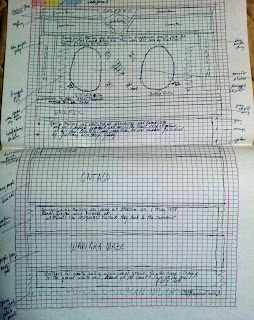
It is full of little puns in the stitches - Winchester for George's public school, Pacific with its waves for their both being in their respective college boats, Lindisfarne for its stained glass effect [there is a stained glass window at the church in Mobberly of George as Sir Galahad, his nickname], their respective college colours. It is meant to emulate that stained glass window, and give a sense of the magnificent colours of the Himalayas, while imparting some knowledge of their lives, in the ways that they were similar (many.) It ends with the closing line of a poem, written in 1909, by George's dear friend and climbing partner, the great Geoffrey Winthrop-Young (who dubbed George Galahad):
I drew up the plan on graph paper immediately.

It is full of little puns in the stitches - Winchester for George's public school, Pacific with its waves for their both being in their respective college boats, Lindisfarne for its stained glass effect [there is a stained glass window at the church in Mobberly of George as Sir Galahad, his nickname], their respective college colours. It is meant to emulate that stained glass window, and give a sense of the magnificent colours of the Himalayas, while imparting some knowledge of their lives, in the ways that they were similar (many.) It ends with the closing line of a poem, written in 1909, by George's dear friend and climbing partner, the great Geoffrey Winthrop-Young (who dubbed George Galahad):
'Brothers 'til Death and a windswept Grave.
Ye who have climbed to the great white Veil -
Heard ye the chant, saw ye the Grail?'
Ye who have climbed to the great white Veil -
Heard ye the chant, saw ye the Grail?'
Below is a picture of some of the stitches - my working sampler - and also a pic of George 'looking as if he's been dragged through a hedge' as one English friend of mine said.


26 December 2011
New 17th C sampler patterns
Ordered Five new charts for exceptional historic 17th Century samplers from The Scarlet Letter. Some are for their patterns, one is for its historical significance, and one is for its relation to my family history (supporters of the Stewart/Stuart cause). As you can see, I love band samplers, and these will keep me going for a while. Once samplers changed to teaching devices for young girls- rather than being records of patterns - both the variety of stitches and the quality declined, so that by the mid 19th Century, they were almost entirely in cross-stitch and some quite crude, both in design and execution. I much prefer the breath-taking intricacy of these from the 'Golden Age of Samplers'.
Elizabeth Paine

Joanna Warren


The Pattern Record
 The Boscobel Oak
This historic sampler from the Fitzwilliam Museum in Cambridge not only has lovely patterns, but depicts symbols associated with Charles Stuart and the English Civil War. As the blurb from The Scarlet Letter says 'The large oak tree in the lower-most panel contains three gold crowns, an obvious reference to the oak tree in the grounds of Boscobel House in Shropshire where Charles II was hidden after fleeing the Battle of Worcester in 1651. The local people assisted him in his escape, which explains the figure of the hunter saluting the tree. '

ER-IT
'Circa 1680... The upper section of the sampler exhibits spot motifs, more often found on samplers of the early 17th century. Hearts, stars, mazes, berries, concealed Stuart symbols, done in a wide variety of stitches characterize this section. Below that are floral and geometric pattern bands, including a row with two wonderful leering little boxers presenting flowers.'

Elizabeth Paine

Joanna Warren

The Pattern Record
 The Boscobel Oak
This historic sampler from the Fitzwilliam Museum in Cambridge not only has lovely patterns, but depicts symbols associated with Charles Stuart and the English Civil War. As the blurb from The Scarlet Letter says 'The large oak tree in the lower-most panel contains three gold crowns, an obvious reference to the oak tree in the grounds of Boscobel House in Shropshire where Charles II was hidden after fleeing the Battle of Worcester in 1651. The local people assisted him in his escape, which explains the figure of the hunter saluting the tree. '

ER-IT
'Circa 1680... The upper section of the sampler exhibits spot motifs, more often found on samplers of the early 17th century. Hearts, stars, mazes, berries, concealed Stuart symbols, done in a wide variety of stitches characterize this section. Below that are floral and geometric pattern bands, including a row with two wonderful leering little boxers presenting flowers.'

Subscribe to:
Posts (Atom)