The lovely lady at Corsetmakers has some fascinating advice - and a vavoom figure! - give EASE at bust and hip and reduce only the waist. This gives somewhere for the flesh to go - even on slender figures, avoids the dreaded muffin top, and allows a smaller waist.
This is why in such shows as the 1900s House when the Mrs went suffragette and refused to wear a corset (because she and her daughter couldn't swim due to their periods, even in period dress) - her
clothes did not fit - and she was pretty rangy. They were loose at the bust and hip and gaped at the waist - exactly the result of the advice given this sempstress.
I could easily go down from 27(natural) to 24 - the 'beginner's waist training reduction - with no prob. Could I go down to 22.5? (yer wan's additional reduction upon tight-lacing) I'm excited to find out!
All of my handmade corsets have thus far not been waist reducing, per se, just to get the period silhouette (most people did not tight-lace.) But I remember fondly how GORGEOUS one of the principals looked when I tight-laced her for Little Mary Sunshine - I pulled the waist way in - meeting - and left the top
and bottom at flex (it was not a fitted to her jobber after all). O my goodness! Lillie Langtry would have envied her figure (which was not naturally spectacular)
27 June 2012


14 April 2012
Aran Jumpers - A Different View

In Ireland, everyday Aran jumpers were made from blue wool or dyed blue (with woad or indigo paper from sugar cones) inasmuch as everyday Ganseys and smocks. As with Ganseys and smocks white was only worn for Sundays. When the Clancy Brothers became popular, with their signature white Arans, a tourist industry was spawned (piecework Arans before this were blue or brown) and now it is rare and difficult to find them in colours for sale, in tourist or other venues.
Wessex Memorial Update 14 April 12
Room has been left for when Sandy is discovered (as I am confident he will be). I was VERY tempted to say 'they likely summited about 5:00 PM' but there really wasn't room for that and Sandy's discovery, and the latter is more important; enough name-brand researchers on the 1999 expedition agree with my thesis about their summit time that I don't need to prove anything to anyone.
The lettering isn't really as complicated as it looks. One bottom blue line of stitching in the starry sky and the lettering took six hours.

The lettering isn't really as complicated as it looks. One bottom blue line of stitching in the starry sky and the lettering took six hours.

09 April 2012
Progress on the Wessex Sampler

The images, which I thought were sticky-backed, are not thus had to be pinned, but are attached by the buttonhole applique method, which is also used with Morris designs for quilting. Embroidering each of the squares in the Lindisfarne takes an hour. The Dunstan pattern at the top is meant to resemble a starry sky; the Winchester motif in the middle of it, the full moon on the night of 8 June, 1924. Clearly someone has done entirely too much research on the expedition! Nerdy as it is, yes, I can tell you what they ate, what they wore, what they read, all on that last day - and for the rest of the expeditions....
23 January 2012
Wessexwork Memorial Sampler
When I first discovered Wessex Stitchery - invented by Margaret Foster in the 1910s - I thought immediately of a memorial sampler for George Leigh-Mallory and Andrew Irvine, who perished on Everest in 1924.
I drew up the plan on graph paper immediately.
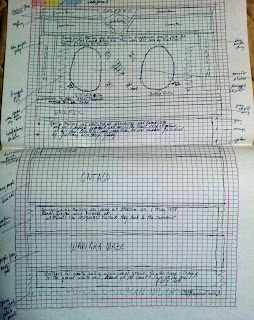
It is full of little puns in the stitches - Winchester for George's public school, Pacific with its waves for their both being in their respective college boats, Lindisfarne for its stained glass effect [there is a stained glass window at the church in Mobberly of George as Sir Galahad, his nickname], their respective college colours. It is meant to emulate that stained glass window, and give a sense of the magnificent colours of the Himalayas, while imparting some knowledge of their lives, in the ways that they were similar (many.) It ends with the closing line of a poem, written in 1909, by George's dear friend and climbing partner, the great Geoffrey Winthrop-Young (who dubbed George Galahad):
I drew up the plan on graph paper immediately.

It is full of little puns in the stitches - Winchester for George's public school, Pacific with its waves for their both being in their respective college boats, Lindisfarne for its stained glass effect [there is a stained glass window at the church in Mobberly of George as Sir Galahad, his nickname], their respective college colours. It is meant to emulate that stained glass window, and give a sense of the magnificent colours of the Himalayas, while imparting some knowledge of their lives, in the ways that they were similar (many.) It ends with the closing line of a poem, written in 1909, by George's dear friend and climbing partner, the great Geoffrey Winthrop-Young (who dubbed George Galahad):
'Brothers 'til Death and a windswept Grave.
Ye who have climbed to the great white Veil -
Heard ye the chant, saw ye the Grail?'
Ye who have climbed to the great white Veil -
Heard ye the chant, saw ye the Grail?'
Below is a picture of some of the stitches - my working sampler - and also a pic of George 'looking as if he's been dragged through a hedge' as one English friend of mine said.


26 December 2011
New 17th C sampler patterns
Ordered Five new charts for exceptional historic 17th Century samplers from The Scarlet Letter. Some are for their patterns, one is for its historical significance, and one is for its relation to my family history (supporters of the Stewart/Stuart cause). As you can see, I love band samplers, and these will keep me going for a while. Once samplers changed to teaching devices for young girls- rather than being records of patterns - both the variety of stitches and the quality declined, so that by the mid 19th Century, they were almost entirely in cross-stitch and some quite crude, both in design and execution. I much prefer the breath-taking intricacy of these from the 'Golden Age of Samplers'.
Elizabeth Paine

Joanna Warren


The Pattern Record
 The Boscobel Oak
This historic sampler from the Fitzwilliam Museum in Cambridge not only has lovely patterns, but depicts symbols associated with Charles Stuart and the English Civil War. As the blurb from The Scarlet Letter says 'The large oak tree in the lower-most panel contains three gold crowns, an obvious reference to the oak tree in the grounds of Boscobel House in Shropshire where Charles II was hidden after fleeing the Battle of Worcester in 1651. The local people assisted him in his escape, which explains the figure of the hunter saluting the tree. '

ER-IT
'Circa 1680... The upper section of the sampler exhibits spot motifs, more often found on samplers of the early 17th century. Hearts, stars, mazes, berries, concealed Stuart symbols, done in a wide variety of stitches characterize this section. Below that are floral and geometric pattern bands, including a row with two wonderful leering little boxers presenting flowers.'

Elizabeth Paine

Joanna Warren

The Pattern Record
 The Boscobel Oak
This historic sampler from the Fitzwilliam Museum in Cambridge not only has lovely patterns, but depicts symbols associated with Charles Stuart and the English Civil War. As the blurb from The Scarlet Letter says 'The large oak tree in the lower-most panel contains three gold crowns, an obvious reference to the oak tree in the grounds of Boscobel House in Shropshire where Charles II was hidden after fleeing the Battle of Worcester in 1651. The local people assisted him in his escape, which explains the figure of the hunter saluting the tree. '

ER-IT
'Circa 1680... The upper section of the sampler exhibits spot motifs, more often found on samplers of the early 17th century. Hearts, stars, mazes, berries, concealed Stuart symbols, done in a wide variety of stitches characterize this section. Below that are floral and geometric pattern bands, including a row with two wonderful leering little boxers presenting flowers.'

07 June 2011
Farb
My eldest, Percival, is going to compete in longsword at Valhalla Faire in South Lake Tahoe this weekend, so we are making it a road trip. It's rather a scramble, as we found out on Sunday that it was THIS weekend. So needed to find accommodation, bunny-sitter, gather food, and so on. And Percival needs a new pair of breeks. Didn't think of that a Yuletide. Drat. So I'm rather busy for the next few days. Anyway, the breeks are something like this Polyvore Costumes:
 But fuller. He's a swordsman, so cannot be poncing about in Court breeches or schlepping about in slops (think ginormous sailor trousers).
As for me, I haven't worked a Faire in yonks, nor even gone, I'm afraid, so I am doing what the childer always do and putting stuff together from my closet. Oh yes. I go to fancy dress parties from my closet. People say 'WHERE did you GET that?' and I say 'These are my clothes....' erm.... I DO have some anxiety about being a farb - inappropriately dressed in pseudo period costume - because I am a costumer, but it can't be helped at short notice. in truth I would be anxious about it unless I had spent weeks making period appropriate garb. Always was.
So many people have asked, when I use the word, what 'farb' or 'farby' means and where it came from. What it means they get from context - attire or accoutrements which excite snarky remarks from re-enactors - but the origin of the word is somewhat up for grabs. It first appeared in the early days of 'Civil War re-enacting' (War Between The States, or the Late Unpleasantness, in our down home environs) in the 1960s. Some say it is from the German for 'colour' (farbre), others that it derives from 'Far BE it from ME to comment on your Period Inappropriate [fill in blank]'. I think the German origin is probably stretching it, but we shall never really know. Anyway, as you can see, being farby is a very bad thing.
Friends don't let friends be farbs, and all that. (Got the t-shirt.)
Why else would one spend countless hours handsewing linen, wool, silk, in period correct manner, if not to avoid the dreaded F word?
Not ever for love of history and detail, perchance.
As for me, I haven't worked a Faire in yonks, nor even gone, I'm afraid, so I am doing what the childer always do and putting stuff together from my closet. Oh yes. I go to fancy dress parties from my closet. People say 'WHERE did you GET that?' and I say 'These are my clothes....' erm.... I DO have some anxiety about being a farb - inappropriately dressed in pseudo period costume - because I am a costumer, but it can't be helped at short notice. in truth I would be anxious about it unless I had spent weeks making period appropriate garb. Always was.
So many people have asked, when I use the word, what 'farb' or 'farby' means and where it came from. What it means they get from context - attire or accoutrements which excite snarky remarks from re-enactors - but the origin of the word is somewhat up for grabs. It first appeared in the early days of 'Civil War re-enacting' (War Between The States, or the Late Unpleasantness, in our down home environs) in the 1960s. Some say it is from the German for 'colour' (farbre), others that it derives from 'Far BE it from ME to comment on your Period Inappropriate [fill in blank]'. I think the German origin is probably stretching it, but we shall never really know. Anyway, as you can see, being farby is a very bad thing.
Friends don't let friends be farbs, and all that. (Got the t-shirt.)
Why else would one spend countless hours handsewing linen, wool, silk, in period correct manner, if not to avoid the dreaded F word?
Not ever for love of history and detail, perchance.
06 June 2011
Robe de Style: Skirt fitting
Have progressed - with several other projects in between - to fitting the pannier skirt. It is cartridge pleated, and arranged in the manner of 18th C. and New Look Skirts - with the fullness over the hips, not across the stomach or backside. The seams were machine sewn with edges turned under. The gathering and application is all by hand.
Front

Side Placket

Back

Side Back

My daughter Bridgie refers to this as my Fairy Princess dress.... That wasn't my intention, but it does bear a strong resemblance to Disney Princess gowns, because Walt used those silhouettes. I'm trying not to make this mean I can't wear it; it's meant for the opera or other such occasions.
Front

Side Placket

Back

Side Back

My daughter Bridgie refers to this as my Fairy Princess dress.... That wasn't my intention, but it does bear a strong resemblance to Disney Princess gowns, because Walt used those silhouettes. I'm trying not to make this mean I can't wear it; it's meant for the opera or other such occasions.
07 May 2011
Robe de Style: Bodice
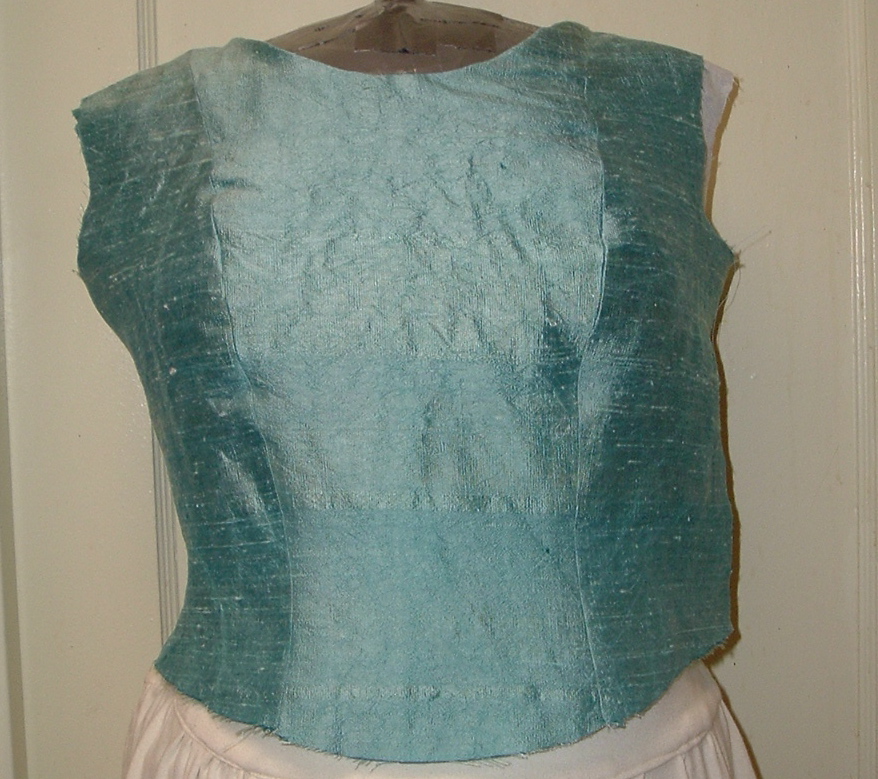
Got to work on the bodice today, after altering an overcoat for my daughter Brigid.... Something I never thought I would do! The bodice is very basic and so went together quickly, with the lining and shell sewn in assembly-line fashion by machine. The neckline is undersewn on the lining side and will have lace seam tape later after the neck ornamentation is done on the shell.


The hooks will go on the left side, so, that side seam is sewn two inches from the armscye.
The sleeves took a deal of time. The embroidered net was first fitted to the sleeve, gathered at the top, then basted. The sleeve underarm sleeve was then sewn and the sleeves handsewn into the armscye, with pleats at the top rather than gathers. The pleats were sewn with backstitches, the rest with a running stitch with a backstitch every few stitches. This is all very 18th Century technique- of which working with the silk reminded me. There was NO way I was going to try to cram this delicate fabric into the machine! Hand-sewing gives much greater control of the layers. No unpleasant surprises.


My idea with the sleeve capes was to tend toward the bertha, which was a favourite neckline treatment in the 1920s; also to use up the bits of fabric I cut from the skirt panels. Robes de style often had puffed sleeves of various kinds, and these sleeve caps are very puffed. The sleeve underneath is not tight-fitted, but semi-fitted, and will eventually have an inverted pleat at the bottom and be finished with lace seam tape.
The silk was lovely to work with, and it was a pleasant way to while away the day. I literally looked up and thought, 'how did it get to be teatime?!' This is how you know the your work is True Play.
I plan to work on the neckline ornamentation this evening; it's all fiddly antique buttons and gilt gimpe, ala Waterhouse's Ophelia, which I look at every day, hanging as it is in the loo.
Update: The ornamentation at the neckline is finished.


The gilt gimpe is from a doublet for Percival last Christmas, the rhinestone buttons from my former hubs' grandmother's button box, and the pearls are from Bridgie's First Communion dress. Yes, I do save all those bits and bobs of oddments, 'because you never know when they will come in useful.'

The hooks will go on the left side, so, that side seam is sewn two inches from the armscye.
The sleeves took a deal of time. The embroidered net was first fitted to the sleeve, gathered at the top, then basted. The sleeve underarm sleeve was then sewn and the sleeves handsewn into the armscye, with pleats at the top rather than gathers. The pleats were sewn with backstitches, the rest with a running stitch with a backstitch every few stitches. This is all very 18th Century technique- of which working with the silk reminded me. There was NO way I was going to try to cram this delicate fabric into the machine! Hand-sewing gives much greater control of the layers. No unpleasant surprises.

My idea with the sleeve capes was to tend toward the bertha, which was a favourite neckline treatment in the 1920s; also to use up the bits of fabric I cut from the skirt panels. Robes de style often had puffed sleeves of various kinds, and these sleeve caps are very puffed. The sleeve underneath is not tight-fitted, but semi-fitted, and will eventually have an inverted pleat at the bottom and be finished with lace seam tape.
The silk was lovely to work with, and it was a pleasant way to while away the day. I literally looked up and thought, 'how did it get to be teatime?!' This is how you know the your work is True Play.
I plan to work on the neckline ornamentation this evening; it's all fiddly antique buttons and gilt gimpe, ala Waterhouse's Ophelia, which I look at every day, hanging as it is in the loo.
Update: The ornamentation at the neckline is finished.


The gilt gimpe is from a doublet for Percival last Christmas, the rhinestone buttons from my former hubs' grandmother's button box, and the pearls are from Bridgie's First Communion dress. Yes, I do save all those bits and bobs of oddments, 'because you never know when they will come in useful.'
23 April 2011
Robe de Style: the other 1920s dress

Was supposed to wear it tomorrow (Easter, to go with my 'Queen Mum' vintage hat from Macy's), but that clearly isn't happening.
It took me five hours to cut it out (making the muslin, fitting, taking apart, re-fitting, finally cutting the silk and the embroidered net.) Somebody - I think it was on Your Wardrobe Unlock'd - said that it's all in the cutting - the make or break of a garment - and I agree. NOBODY is like a pattern except the dressmakers' dummies, and the fitting muslin often looks pretty weird. All I can say is, Thank God for the sloper I made, and for Jeanne, my modèle de modiste; those two together make the world of difference... oh and the cutting table, of course. If I had to crawl around o n the floor doing this, or have everything half hanging off the dining table I'd give up. I LIKE handsewing and sitting like a tailor in the window - shades of a pastlife in London? - I like cutting and fitting, I could do it all day and never tire, but the physical comfort of the job means a lot.
My version is very modest, with a scoop neck and short sleeves. Mme. Lanvin used to make them up for all ages of women and the older the woman the higher the neckline and longer the sleeves. But it's abundant with embroidered net - the genesis of the project - antique buttons, ribbon flowers, and charm. The main fabric is from a bolt of turquoise tussah silk I got for an 18th Century gown and never made, because the gig was canceled, I have now used it for two dresses, and have enough leftover for a combing jacket, if not a dressing gown. The original late 18th Century gown was supposed to be a robe a la Francaise for maternity, which is why the enormous amount of fabric.
I have decided that Americans do not have waists because I have to not only take off a bunch at the sides, but make EVERYTHING a cuirass waist (like in the bustle period and 50s, where 'straight' lines - centre front etc. - are actually curved to fit the body. The patterns also have WAY too much ease. This is an old Laura Ashley pattern - it was the nearest shape - and it was originally cut for a size 6; it is still cut for a size 6 - 23 years later, but with 1/2" rather than 5/8" seams, even though I've got a good ten pounds on those days. AND I still had to curve the front side seams! As I recall, it was pretty loose from the underbust to the high hip, but it was for a day dress, so I didn't care. This dress, I care. I'm making it to fasten at the left side, as was correct, rather than zip up the back as the pattern calls for. I could have it zip up the side, but I don't want to. Hooks.
All the foufy bits - the embroidered net et al - is what makes it and it would be easy to go overboard - I had to reign myself in from expanding on my original design. I hope this will be worthy of Mme. Lanvin.
Will post photos as I go along. Did not post of the fiddly fitting and cutting because you all know about that.
Subscribe to:
Posts (Atom)