Exquisite Creations. Everyday Romanticism. Timeless elegance. The Embodiment of the Arts & Crafts.
Showing posts with label Artistic Dress. Show all posts
27 May 2015
Hand versus Machine Embroidery
I am often asked why hand embroidery is so expensive, or why I would do it, as it 'takes so long', or why I do not have an embroidery machine as they are 'faster' and 'more professional.' The everyday world has become so accustomed to the simple chain or satin stitch of machine embroidery, on t-shirts, hats, and what-you-will, that this is regarded as 'normal', even preferable to fine hand embroidery.
Yes, handmade embroidery is very time consuming, but it requires real workmanship, and is inherently more valuable than mass produced, machine-made embroidery. High quality handmade embroidery is collectible while machine-made embroidery is not. And that is why I do it.
Of course I have used machine-made entredeaux and laces for everyday items, because making lace is also a time-consuming, therefore expensive art, and hand-made insertions increase the time and cost of everyday items. But for embroidery, I definitely do not want something that is a cousin to Mouse ears from Disneyland.
The question of hand-versus-machine is not new, and is central to the impetus that gave birth to the Arts & Crafts Movement; it has its origins in the Industrial Revolution at the turn of the 18th and 19th Centuries, along with cotton gins, weaving machines, and steam engines.
The first embroidery machine was made in France, in 1828, patented by Josue Heilmann. It was run by four people, and could do embroidery work in about one quarter the time of the fastest hand embroiderers. The machine posed a serious threat to the hand-embroidery industry at the time, and they were largely banned in Switzerland. But even there, embroidery machines caught on, and in 1863 by Isaac Groebli invented the Schiffli machine, which could stitch in any direction. Singer touted its sewing machine - while still in the treadle stage - as being useful for machine embroidery, done with a hoop as in with modern free-motion machines. Eventually, Singer developed its own embroidery machine.
There are those who would aver that the embroidery of these machines cannot be distinguished from hand work. However, there are notable differences: machines connect motifs, whether on a border or in a central design; the stitching is 'regular' - of an even length but not necessarily fit to the motif, so the work can look choppy; and until the advent of digitised machines, there were a limited number of stitches possible. The main drawback is that the machine (digitised or not) cannot cope with subtle shadings or make stitch and design choices which distinguish art embroidery, including couture. Yes, couture pieces are hand-embroidered, with the embroidery being fit to the design of the garment the colour, the scale of the wearer, and so on.
From the Middle Ages, most professional embroiderers were men belonging to a Guild which had strict apprenticeships and rules of working for journeymen; women were left to embroidering personal items and decorative arts for the home. Church vestments, spotting of fabrics, men's tailoring, all these were embroidered by men. We have Mr. Morris and the Arts and Crafts Movement to thank for bringing women into the profession, as designers and producers as well as cottage-industry workers.
There is a charming and false view of the domestic use of embroidery machines as a family enterprise in the 19th Century: 'As easily used at home as in a factory, a downstairs room of a suitable size would be needed to house the machine. If a machine embroidery business existed in a home, the entire family was usually involved in the process. Generally, the father would oversee the machine’s operation and the wife and children would thread the bobbins, tend to the thread, and so forth.'
Given the size and expense of embroidery machines, and the size and income of the average 19th Century hovel, this is a quaint and dangerously erroneous vision of 19th Century life. I have ancestors who worked in wool and linen and thread mills - father, mother and children of both genders - and they'd have had to amass quite a sum of money to afford one of these machines, or room for it, something hardly possible on the wages of the time.
This brings up the real reason why modern embroidery is so cheap, and if one happens to find something hand-embroidered, it is not cheap, but was produced in China, Maylasia, India, or Indonesia, by people who are earning less than a dollar a day, or worse. They are working in the same miserable, noisy conditions as our 19th Century ancestors, going blind or crippled, for a pittance, while the Boss Man makes all the money.
It is true that the cost of fine craftsmanship in the Arts & Crafts was detrimental to its goal of 'Art for the People', but it is possible now to pay a reasonably fair wage - the $15 an hour much-touted fair minimum wage - and produce beautiful, unique, handmade items in conditions which are humane.
This is why I am a hand-embroiderer, and offer hand-embroidered goods.
28 April 2015
Transitional Fashions, a Survey
In the study of fashion, I have come to realise that I really like the transitional periods best, when shapes and forms were fluid and changing from one long-established mode to a new and different one. This is true from the Jacobean through the modern periods. Here we will examine the the aspects that changed in these periods and see if there are any common features to transitional fashions.
In the period of James VI/I, we begin to see softer silhouettes than the previous Tudor styles, moving towards the loose, billowy styles of the Stuart monarchy in the mid 17th Century.
In the Rubens portrait, we see in his flowing doublet skirts the beginning of a coat, and in the longer breeches, the petticoat breeches of mid-century. Our lady in the second example still has the form of the Tudor dress style, but gone is the conical bodice shape and farthingale. The prevailing mode is a softening of the more geometric forms of the previous period.
A century later, in the transition from the Stuart to Georgian (Hanoverian) periods, we again find change in dress, this time from a large blowsy silhouette (as it had become) to a slimmer one that was less ornamented (briefly).
Here we do not see the enormous cuffs on the man's coat that we saw earlier, and will again later, nor in the woman's ensemble the beribboned bodice of the late Stuart or the wide hoop to come that would define Court dress for a century. There is a purity of form, the clothing reduced to essentials.
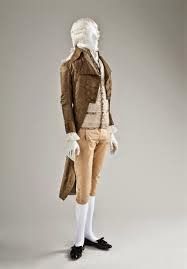
In the 1790s again we see change, not entirely, as has been supposed, due to the influence of the demise of the Ancien Régime, but of the natural flow of fashion trends. From the 1770s, the silhouette had been simplifying and reducing, refining once again to its most essential components, until in the late 1780s, an almost severe form emerged.
In short order, the breeches in that severe suit would become pantaloons (trousers), and the modest embroidery would disappear from men's waistcoats virtually forever. in the woman's gown, all the experimental stages of zones, chemises a la reine, and overskirts have disappeared, leaving a simple gown that shows clearly the direction the waist will go and the form that will dominate for the next thirty years.
Our periods of change are now becoming more rapid, and will do so increasingly into our contemporary period, where fashions shift almost with the seasons.
On the late 1820s and early 1830s, the transition went from straight, severe unornamented forms to a descent to the natural waist for women, a widening of the shoulders, for both men and women, a lengthening of the men's frock coats, and a widening of the skirts of women's gowns.
The natural form of the body is celebrated in both cases, giving charm and attractiveness to the costume, but it is significant that with the exception of waistcoats and cravats, men's clothing will remain subdued with a few extraordinary exceptions (the Pre-Raphaelite Brotherhood, the Artistic Dress of Oscar Wilde and company).
The 1880s were the height of Artistic and Reform Dress, co-inciding with each other in form if not in expression.
In the Artistic Dress examples, we see rich fabrics used in loose and comfortable clothing, which does not exaggerate any part of the body; it follows the natural form. This is also true of reform dress, in the second set of examples. Comfort, if not highly artistic expression, is favoured in, for the man, a loose soft collar and cravat and plain sack coat. In the women's coats, there is no exaggeration of bustles, the hemline is off the ground and the ornamentation is minimal.
Our final example, of the very late 1910s and early 1920s, also shows the same loosening of strictures of dress of the previous decades, with more than hints of fashion to come.
In the man's fur coat, there is an almost last-hurrah of personal style before the 1960s loosened men's attire once more. In this period, we see the advent of the ascot, worn for informal dress, the college jacket (typically striped), and innumerable Fair Isle knitted waistcoats, which allowed men some personal style expression. Informality of dress was almost a catchphrase of the 1920s, and here we see its advent at the end of the Great War.
In the women's frocks, we still see the dainty ornament of the 1910s lingerie frocks, but the structure has loosened and overblouses and tunics presaged the dropped or eliminated waist to come. The clothing is still pretty, feminine and comfortable, with the natural as the focus.
In our brief survey, we have found that the commonalities of transitional periods are: a reduction of the style to its essential form, emphasis on the natural form of the body, a reduction of (or increase of) ornamentation in response to the previous period, a loose, soft style, and a (relatively) slow movement from one style to another based on an organic process (not imposed from without by fashion designers). These elements, then, might justifiably be seen as the hallmarks of natural fashions, suitable to all time periods and styles.
In the period of James VI/I, we begin to see softer silhouettes than the previous Tudor styles, moving towards the loose, billowy styles of the Stuart monarchy in the mid 17th Century.
In the Rubens portrait, we see in his flowing doublet skirts the beginning of a coat, and in the longer breeches, the petticoat breeches of mid-century. Our lady in the second example still has the form of the Tudor dress style, but gone is the conical bodice shape and farthingale. The prevailing mode is a softening of the more geometric forms of the previous period.
A century later, in the transition from the Stuart to Georgian (Hanoverian) periods, we again find change in dress, this time from a large blowsy silhouette (as it had become) to a slimmer one that was less ornamented (briefly).
Here we do not see the enormous cuffs on the man's coat that we saw earlier, and will again later, nor in the woman's ensemble the beribboned bodice of the late Stuart or the wide hoop to come that would define Court dress for a century. There is a purity of form, the clothing reduced to essentials.
In the 1790s again we see change, not entirely, as has been supposed, due to the influence of the demise of the Ancien Régime, but of the natural flow of fashion trends. From the 1770s, the silhouette had been simplifying and reducing, refining once again to its most essential components, until in the late 1780s, an almost severe form emerged.
In short order, the breeches in that severe suit would become pantaloons (trousers), and the modest embroidery would disappear from men's waistcoats virtually forever. in the woman's gown, all the experimental stages of zones, chemises a la reine, and overskirts have disappeared, leaving a simple gown that shows clearly the direction the waist will go and the form that will dominate for the next thirty years.
Our periods of change are now becoming more rapid, and will do so increasingly into our contemporary period, where fashions shift almost with the seasons.
On the late 1820s and early 1830s, the transition went from straight, severe unornamented forms to a descent to the natural waist for women, a widening of the shoulders, for both men and women, a lengthening of the men's frock coats, and a widening of the skirts of women's gowns.
The natural form of the body is celebrated in both cases, giving charm and attractiveness to the costume, but it is significant that with the exception of waistcoats and cravats, men's clothing will remain subdued with a few extraordinary exceptions (the Pre-Raphaelite Brotherhood, the Artistic Dress of Oscar Wilde and company).
The 1880s were the height of Artistic and Reform Dress, co-inciding with each other in form if not in expression.
In the Artistic Dress examples, we see rich fabrics used in loose and comfortable clothing, which does not exaggerate any part of the body; it follows the natural form. This is also true of reform dress, in the second set of examples. Comfort, if not highly artistic expression, is favoured in, for the man, a loose soft collar and cravat and plain sack coat. In the women's coats, there is no exaggeration of bustles, the hemline is off the ground and the ornamentation is minimal.
Our final example, of the very late 1910s and early 1920s, also shows the same loosening of strictures of dress of the previous decades, with more than hints of fashion to come.
In the man's fur coat, there is an almost last-hurrah of personal style before the 1960s loosened men's attire once more. In this period, we see the advent of the ascot, worn for informal dress, the college jacket (typically striped), and innumerable Fair Isle knitted waistcoats, which allowed men some personal style expression. Informality of dress was almost a catchphrase of the 1920s, and here we see its advent at the end of the Great War.
In the women's frocks, we still see the dainty ornament of the 1910s lingerie frocks, but the structure has loosened and overblouses and tunics presaged the dropped or eliminated waist to come. The clothing is still pretty, feminine and comfortable, with the natural as the focus.
In our brief survey, we have found that the commonalities of transitional periods are: a reduction of the style to its essential form, emphasis on the natural form of the body, a reduction of (or increase of) ornamentation in response to the previous period, a loose, soft style, and a (relatively) slow movement from one style to another based on an organic process (not imposed from without by fashion designers). These elements, then, might justifiably be seen as the hallmarks of natural fashions, suitable to all time periods and styles.
Subscribe to:
Posts (Atom)