Showing posts with label vintage. Show all posts

12 May 2015

The Romantic Wedding

Wedding season being upon us shortly, our thoughts naturally turn to silk tulle and orange blossom. But wait, need the bride be attired in white if it suits her not? Why not a garland of myrtle or rosemary, or bay, as the Romans and Elizabethans did? Certainly a Romantic bride is not limited to the choice of Queen Victoria in the colour of her gown, nor to roses or garden flowers in her bouquet or corsage. Herbs may be added to a standard flower bouquet or garland or subsume it entirely, using the Language of Flowers to carry a special message on the day:

Burnet: a merry heart
Calendula: health, joy
Carnation: admiration, pure love
Dill: good spirits
Heartsease (Johnny-jump-up): happy thoughts
Ivy: fidelity, wedded love
Lamb’s-ears: support
Lavender: devotion, undying love, luck
Lemon Verbena: unity
Marjoram: blushes, joy
Mint: warmth of feeling
Myrtle: fidelity, everlasting love, married bliss
Oregano: joy, happiness
Parsley: festivity
Queen-Anne’s-lace: protection
Rose (pink): beauty, grace
Rose (red): passion, love, luck
Rose (white): unity, love, respect, innocence
Rose geranium: preference
Rosemary: remembrance, fidelity, luck
Sage: domestic virtue, long life
Silver-king artemisia: sentimental recollections
Thyme: courage, strength
Verbena: faithfulness, marriage
Wormwood: affection
Yarrow: everlasting love

Queen Victoria aside, wedding dresses were not often white until quite recently, as the dress would be slightly remade to be the best evening or dinner dress. Of colours, any suitable to her complexion may be used, and although black is considered of ill-luck and becoming to few, some Winters may carry it off, in whole or in part of the costume, with aplomb.

In the 1840s, whites extended to ivory, beige,  blonde, eggshell, oyster, and ecru, with satin being the most popular fabric choice. These would be suitable to Springs, Summers, and Autumns.

In the 1850s, figured silks were popular in pale colours of blue, yellow, peach and pink, suitable to Springs and Summers.

 In the 1860s, textures silks and satins were often seen, with colours ranging from  ecru to dusty blue (blue being a very popular choice in all ranges). The item below would be very good for Summers.

The 1870s saw a great deal of colour in wedding dresses, ranging from tan, to sage green to rust. Silk was still favoured as the material of choice. These colours would suit Autumns.


The 1880s saw the re-emergence of brocade and other rich fabrics. Whites tended to be in the range of ivory to beige, and pinks and blues were used as accents. Darker colours were also fashionable, as the deep plum below, suitable for Winters.


The 1890s saw a great deal of detailed trim on non-shiny silk. Beading, embroidery, tulle ruching, often in colours, relieved the white or ivory choice. Mid tones of grey, lilac, and periwinkle blue were  seen. These would suit all seasons.


The turn of the century, the 1900s, saw the dainty use of fine lace and tulle for gowns, with ivory being the most popular white, and heavier laces such as Irish crochet for a richer look. These were often lined in pale colours of pink, yellow, blue and green, suitable to Springs, Summers, and Autumns.

The 1910s continued the trend of layered net and lace, with coloured silks underlays, beading and embroidery, in pastel to medium colours. Blue, lilac, and all shades of pink were popular, suitable to all seasons.
For those interested in our wedding dress range, please visit our virtual catalogue on Pinterest at Brother Rabbit Weddings.
28 April 2015

Transitional Fashions, a Survey

In the study of fashion, I have come to realise that I really like the transitional periods best, when shapes and forms were fluid and changing from one long-established mode to a new and different one. This is true from the Jacobean through the modern periods. Here we will examine the the aspects that changed in these periods and see if there are any common features to transitional fashions.

In the period of James VI/I, we begin to see softer silhouettes than the previous Tudor styles, moving towards the loose, billowy styles of the Stuart monarchy in the mid 17th Century.


In the Rubens portrait, we see in his flowing doublet skirts the beginning of a coat, and in the longer breeches, the petticoat breeches of mid-century.  Our lady in the second example still has the form of the Tudor dress style, but gone is the conical bodice shape and farthingale. The prevailing mode is a softening of the more geometric forms of the previous period.

A century later, in the transition from the Stuart to Georgian (Hanoverian) periods, we again find change in dress, this time from a large blowsy silhouette (as it had become) to a slimmer one that was less ornamented (briefly).


Here we do not see the enormous cuffs on the man's coat that we saw earlier, and will again later, nor in the woman's ensemble the beribboned bodice of the late Stuart or the wide hoop to come that would define Court dress for a century. There is a purity of form, the clothing reduced to essentials.

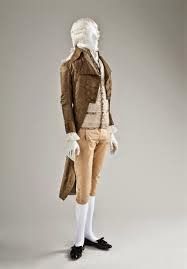
In the 1790s again we see change, not entirely, as has been supposed, due to the influence of the demise of the Ancien Régime, but of the natural flow of fashion trends. From the 1770s, the silhouette had been simplifying and reducing, refining once again to its most essential components, until in the late 1780s, an almost severe form emerged.


 In short order, the breeches  in that severe suit would become pantaloons (trousers), and the modest embroidery would disappear from men's waistcoats virtually forever. in the woman's gown, all the experimental stages of zones, chemises a la reine, and overskirts have disappeared, leaving a simple gown that shows clearly the direction the waist will go and the form that will dominate for the next thirty years.

Our periods of change are now becoming more rapid, and will do so increasingly into our contemporary period, where fashions shift almost with the seasons.

On the late 1820s and early 1830s, the transition went from straight, severe unornamented forms to a descent to the natural waist for women, a widening of the shoulders, for both men and women, a lengthening of the men's frock coats, and a widening of the skirts of women's gowns.


The natural form of the body is celebrated in both cases, giving charm and attractiveness to the costume, but it is significant that with the exception of waistcoats and cravats, men's clothing will remain subdued with a few extraordinary exceptions (the Pre-Raphaelite Brotherhood, the Artistic Dress of Oscar Wilde and company).

The 1880s were the height of Artistic and Reform Dress, co-inciding with each other in form if not in expression.


In the Artistic Dress examples, we see rich fabrics used in loose and comfortable clothing, which does not exaggerate any part of the body; it follows the natural form. This is also true of reform dress, in the second set of examples. Comfort, if not highly artistic expression, is favoured in, for the man, a loose soft collar and cravat and plain sack coat. In the women's coats, there is no exaggeration of bustles, the hemline is off the ground and the ornamentation is minimal.

Our final example, of the very late 1910s and early 1920s, also shows the same loosening of strictures of dress of the previous decades, with more than hints of fashion to come.


In the man's fur coat, there is an almost last-hurrah of personal style before the 1960s loosened men's attire once more. In this period, we see the advent of the ascot, worn for informal dress, the college jacket (typically striped), and innumerable Fair Isle knitted waistcoats, which allowed men some personal style expression. Informality of dress was almost a catchphrase of the 1920s, and here we see its advent at the end of the Great War.

In the women's frocks, we still see the dainty ornament of the 1910s lingerie frocks, but the structure has loosened and overblouses and tunics presaged the dropped or eliminated waist to come. The clothing is still pretty, feminine and comfortable, with the natural as the focus.

In our brief survey, we have found that the commonalities of transitional periods are: a reduction of the style to its essential form, emphasis on the natural form of the body, a reduction of (or increase of) ornamentation in response to the previous period, a loose, soft style, and a (relatively) slow movement from one style to another based on an organic process (not imposed from without by fashion designers). These elements, then, might justifiably be seen as the hallmarks of natural fashions, suitable to all time periods and styles.

19 December 2014

DIY Hairpieces for the Lady Re-enactor, Part One

Some time ago, I purchased a cheap child's Rapunzel wig at Party City, as an alternative to more expensive hairpieces at Sally's or online. This was done for two reasons: ease of acquisition, and the fact that my natural haircolour is now a variegated sandy ginger blonde, which is very difficult to match.

The original wig was closer than anything else found, including the Sandy Blonde wefts at Sally's.
The first necessity was to tone down the unnatural blonde a bit. Into a pot with several dark Irish tea bags went the wig, soaking overnight. Then into a similar pot of dilute Manic Panic Atomic Turquoise conditioner, which is what I use to tone my hair around here. Easy, non-chemical, vegan. This was the resulting colour:

When the wig was dry, I combed it out with a shower comb and began to cut apart the wefts from the wig cap:


Don't be dismayed if you accidentally cut the weft, especially around the front edge.


When all the bottom wefts were off, I arranged then according to size:


The very top, I left whole as the basis for a fall of curls, as my primary hairstyle for Pre-Raphaelitism is 1870s:

The small wefts were then sewn together in pairs. they will be used for side curls, braids, and back curls, depending on need:

These will all go woven into my own hair, which, although hip length, still is not enough to make up the hairstyles of the 1820s-1900 to my satisfaction.  Some of this volume in the latter period may be created with pads and frizzing, but not the mass of curls of the earlier periods.

The switches were then braided loosely so as to avoid tangling, ready for the next part of the adventure, curl-papers and rags:


 As every reader of Victoriana knows, curling rags were used in the period, as an alternative to curling tongs (irons), which did not damage the hair. Some used curl papers instead, including Lord Byron and Beau Brummel.

More on which anon!

18 October 2014

Readying for Winter

At this time of year in the Northern Hemisphere, the weather can be changeable, with 'Indian Summer' - warm days and cold nights, hot one day and cold the next, snow, rain, or humidity all in one week in some areas. However, this is a perfect time to get one's house and wardrobe - and that of the family - ready for winter.


Mrs. Beeton, in her Book of Household Management says, 'In September and October it will be necessary to prepare for the cold weather, and get ready the winter clothing for the various members of the family. The white summer curtains will now be carefully put away, the fire-places, grates, and chimneys looked to, and the house put in a thorough state of repair.'

For our purposes, this is the time to rotate the linens, from summer cottons and coverlets to winter flannels and quilts. The former will want a wash, and the latter an airing, before being laid away in herbs to protect the beautiful starching from vermin, or to be laid upon the beds. Carefully examine the household linen, with a view to its being repaired, if necessary, before cleaning or airing.

Woolens likewise can be freshened, being well shaken and brushed, after being taken out of their pinning upon paper or linen, and camphor (to keep them from moths.) This is true for knitwear as well as cloth.

If your find that you are in need of knitwear or fashionable winter Artistic dress  now is the time to make them, or seeing to having items made, so to be ready for the first really cold days.

Sprucing up a pair of boots:
A lovely quilted winter bonnet:


Stylish Knitwear:


03 October 2010

Ladies of a Certain Vintage

Recently, in a fit of middle-aged frustration, I bought a vintage open-bottom girdle. How vintage? Almost as old as my mother, who was born not long after the US entered the Second War. I got it because I was depressed by the fact that while my weight hasn't really changed since my daughter Bridgie was born - over 20 years ago - things are shall we say, re-arranging themselves, especially since the climacteric has begun in earnest. And alas,  my lovely Edwardian corset is creaky and does not allow me to wear knits. Hence the girdle. I looked, sceptically, at 'shapewear' in the better shops and decided it couldn't do the job, which a perusal of others' opinions on the 'net confirmed.  Spanx just can't cut it.

There are all sorts of emotions attached to this sort of contraption - wildly varying emotions, rather like the climacteric: from weepy nostalgia for my elegant mother, to a lingering hippie disgust because I never thought that I of all people would wear such a thing (and before having children never needed it as I had a stick figure), to a certain unmentionable delight in the sheer Old Hollywood seductiveness of it.

So I put it on, a feat in itself, worthy of corsetry (to which I am well-used). A few adjustments later - it was too large in the waist  - and... vavoom baby! Oh I was hooked. Hooked zipped and sunk for life. What else do you say when it looks marvelous and feels splendid? I rushed to put on a vintage 1940s knit dress. Glory Hallelujah! It was smashing.  The kind of look that makes you want to rush to put on stockings and scarlet lipstick.

What I found over the next few days of breaking it in is that I missed it when I wasn't wearing it. The hippie child who used not to wear brassieres (because I really didn't need to) had become a fully fledged  pin up girl. Eek!

I found myself thinking, Obviously, since I can't wear this with jeans (or even trousers) on the rare occasions I wear them, what do I do? Enter the search and find mission for a vintage panty girdle pattern (which I found, on Etsy, circa 1970) and a vintage pink cotton girdle - from Sears & Roebuck! - from the late 1940s.

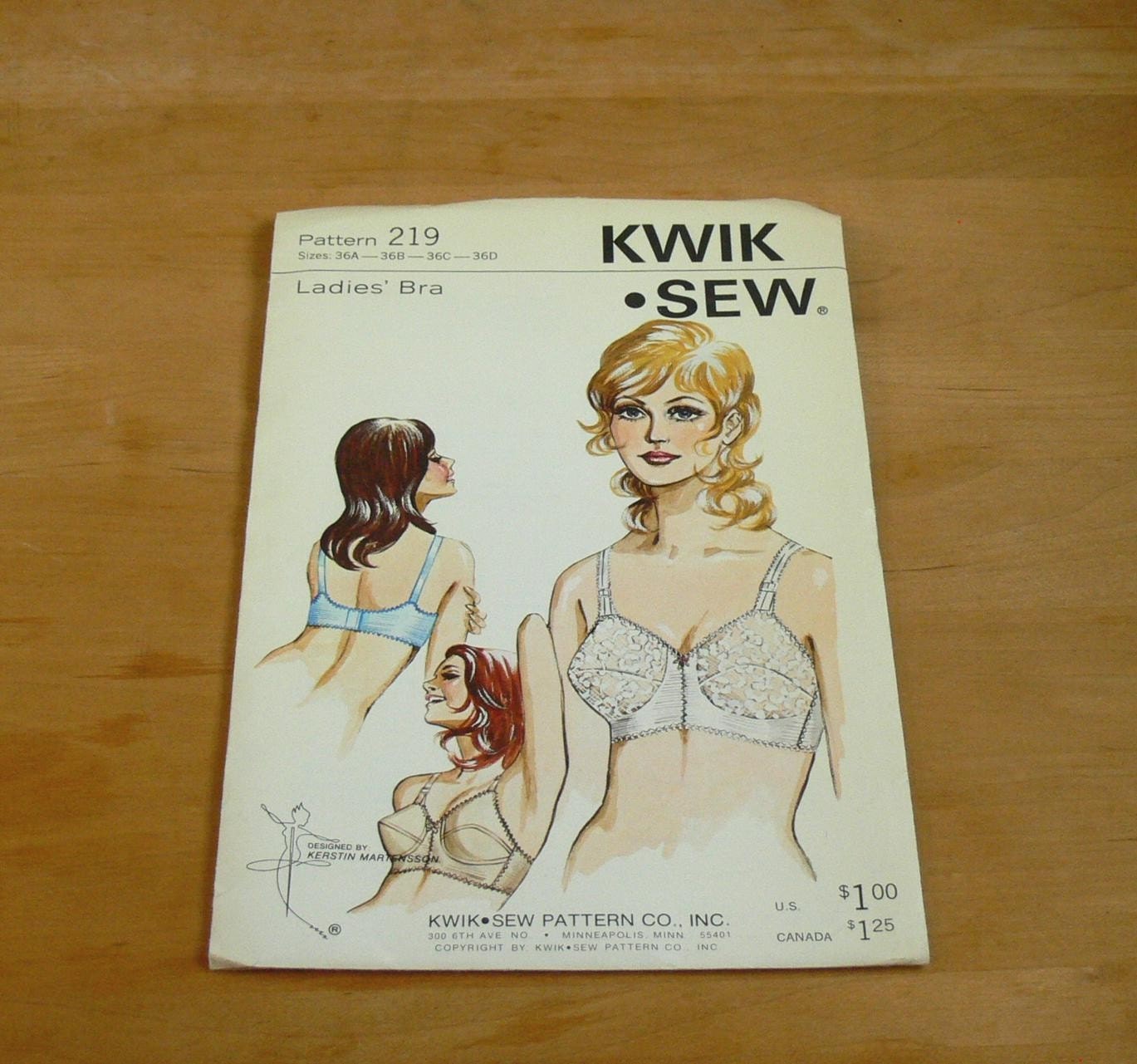
I then searched for the heavy duty powernet to make the panty girdle (and discovered how many men were mad about them, go figure!) and in the midst of all this thought - well, while I'm at it, why don't I make some nice vintage bras too? So got an old Kwik Sew pattern on Etsy.

It has become an obsession, this vintage undies thing, and I spent the day researching and drawing exactly what I wanted, from Victorian to 70's boho. The one decade I gave a miss was the 40s as the difference between it and the 30s wasn't so great as to warrant it. Now I have several sketchbook pages of designs I like that will suit my figure, wardrobe and taste. No underwire! No elastic straps! No 'wardrobe malfunction' balconets!

In the old days a lady tended to have a signature colour for lingerie. Mine is ballet pink with ecru lace. I plan to do everything in this, in rayon, charmeuse, or batiste, as applicable. The whole show: bras, knickers, chemises,  nightgowns, peignoirs. The one thing I can't make is stockings, so Berkshire is safe.

To be beautiful and elegant in and under clothes, with comfort and modesty. That's not a bad how do you do for a moment of hormonal despair.