07 May 2011

Robe de Style: Bodice

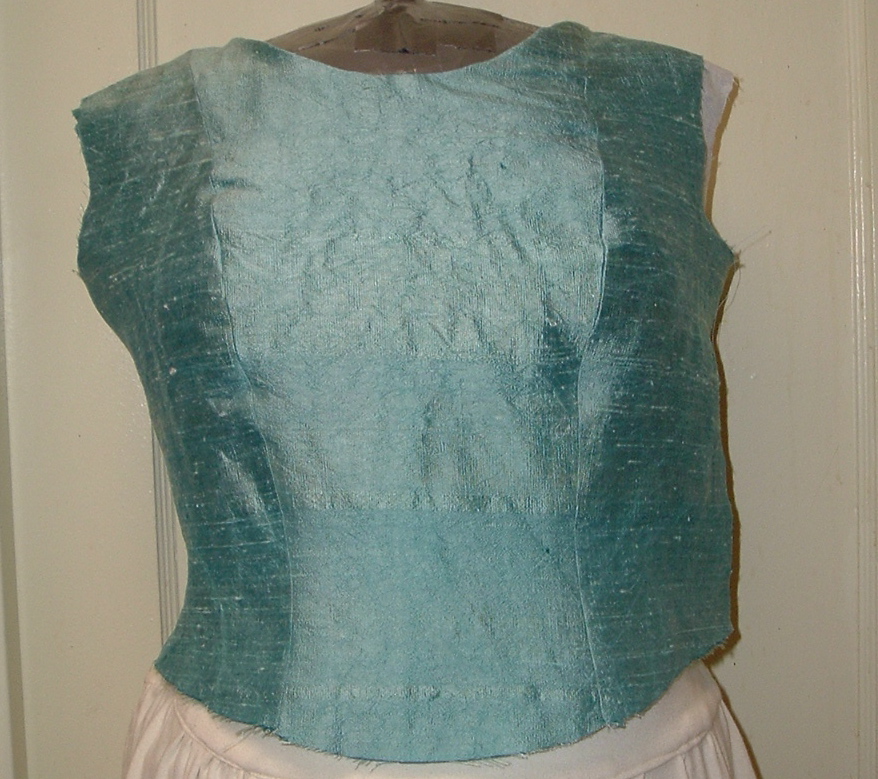
Got to work on the bodice today, after altering an overcoat for my daughter Brigid.... Something I never thought I would do! The bodice is very basic and so went together quickly, with the lining and shell sewn in assembly-line fashion by machine. The neckline is undersewn on the lining side and will have lace seam tape later after the neck ornamentation is done on the shell.


The hooks will go on the left side, so, that side seam is sewn two inches from the armscye.

The sleeves took a deal of time. The embroidered net was first fitted to the sleeve, gathered at the top, then basted. The sleeve underarm sleeve was then sewn and the sleeves handsewn into the armscye, with pleats at the top rather than gathers. The pleats were sewn with backstitches, the rest with a running stitch with a backstitch every few stitches. This is all very 18th Century technique- of which working with the silk reminded me. There was NO way I was going to try to cram this delicate fabric into the machine! Hand-sewing gives much greater control of the layers. No unpleasant surprises.


My idea with the sleeve capes was to tend toward the bertha, which was a favourite neckline treatment in the 1920s; also to use up the bits of fabric I cut from the skirt panels. Robes de style often had puffed sleeves of various kinds, and these sleeve caps are very puffed. The sleeve underneath is not tight-fitted, but semi-fitted, and will eventually have an inverted pleat at the bottom and be finished with lace seam tape.

The silk was lovely to work with, and it was a pleasant way to while away the day. I literally looked up and thought, 'how did it get to be teatime?!' This is how you know the your work is True Play.

I plan to work on the neckline ornamentation this evening; it's all fiddly antique buttons and gilt gimpe, ala Waterhouse's Ophelia, which I look at every day, hanging as it is in the loo.

Update: The ornamentation at the neckline is finished.


The gilt gimpe  is from a doublet for Percival last Christmas, the rhinestone buttons from my former hubs' grandmother's button box, and the pearls are from Bridgie's First Communion dress. Yes, I do save all those bits and bobs of oddments, 'because you never know when they will come in useful.'

23 April 2011

Robe de Style: the other 1920s dress

I finally cut out my blue dress!
Was supposed to wear it tomorrow (Easter, to go with my 'Queen Mum' vintage hat from Macy's), but that clearly isn't happening.

It took me five hours to cut it out (making the muslin, fitting, taking apart, re-fitting, finally cutting the silk and the embroidered net.) Somebody - I think it was on Your Wardrobe Unlock'd - said that it's all in the cutting - the make or break of a garment - and I agree. NOBODY is  like a pattern except the dressmakers' dummies, and the fitting muslin often looks pretty weird. All I can say is, Thank God for the sloper I made, and for Jeanne, my modèle de modiste; those two together make the world of difference... oh and the cutting table, of course. If I had to crawl around o n the floor doing this, or have everything half hanging off the dining table I'd give up. I LIKE handsewing and sitting like a tailor in the window - shades of a pastlife in London? - I like cutting and fitting, I could do it all day and never tire, but  the physical comfort of the job means a lot.

My version is very modest, with a scoop neck and short sleeves. Mme. Lanvin used to make them up for all ages of women and the older the woman the higher the neckline and longer the sleeves. But it's abundant with embroidered net - the genesis of the project - antique buttons, ribbon flowers, and charm. The main fabric is from a bolt of turquoise tussah silk I got for an 18th Century gown and never made, because the gig was canceled, I have now used it for two dresses, and have enough leftover for a combing jacket, if not a dressing gown. The original late 18th Century gown was supposed to be a robe a la Francaise for maternity, which is why the enormous amount of fabric.

I have decided that Americans do not have waists because I have to not only take off a bunch at the sides, but make EVERYTHING a cuirass waist (like in the bustle period and 50s, where 'straight' lines - centre front etc. - are actually curved to fit the body. The patterns also have WAY too much ease. This is an old Laura Ashley pattern - it was the nearest shape - and it was originally cut for a size 6; it is still cut for a size 6 - 23 years later, but with 1/2" rather than 5/8" seams, even though I've got a good ten pounds on those days. AND I still had to curve the front side seams! As I recall, it was pretty loose from the underbust to the high hip, but it was for a day dress, so I didn't care. This dress, I care. I'm making it to fasten at the left side, as was correct, rather than zip up the back as the pattern calls for. I could have it zip up the side, but I don't want to. Hooks.

All the foufy bits - the embroidered net et al - is what makes it and it would be easy to go overboard - I had to reign myself in from expanding on my original design. I hope this will be worthy of Mme. Lanvin.

Will post photos as I go along. Did not post of the fiddly fitting and cutting because you all know about that.

21 April 2011

ABC's of me...

Form courtesy of Margaret (click on name) at Margaret's Blog.

A - Age: 48
B - Bed size: Double. Single
C - Chore you hate: washing up the dishes. it was my chore as a child. Actually, I just hate the idea.
D - Dog's name: no dog. HAD a collie named MacTavish...
E - Essential start of the day item: TEA!
F - Favorite color: Green, no red, no...augh... Seriously, Green
G - Gold or Silver: Gold - preferably old
H - Height: 5'3"
I - Instruments you play: keyboard, guitar, harp, recorder, mountain dulcimer
J - Job: Administrative Assistant
K - Kids: 3 lovely grown people
L - Living arrangements: Single, with bunny
M - Music you love: Folk, bluegrass, classic rock, classical, historical
N - Nicknames: 'Apple blossom' (grandmother), Kell (never asked anyone to call me this, they just do, everyone does.)
O - Overnight hospital stay at hospital: preemie, tonsilitis, bone spur, babies
P - Pet Peeve(s): 'Cutesy' Oirish songs (e.g. Danny Boy etc. My birthday is St. Patrick's, can you say shamrocks?); petty bureaucracy whose sole purpose is to perpetuate itself.
Q - Quote from a movie: 'Did it not seem real? Did it not seem like the old days?' -From Ken Burns 'The Civil War' - okay, so it's a dicumentary.
R - Right handed or left: both
S - Siblings: 2 sisters, one deceased
T - Time you wake up: 6 AM
U - Underwear: Vintage
V - Vegetable you dislike: parsnips
W - Workout Style: yoga, gardening, hiking, climbing, English country dance. Not into gyms. Really not.
Y - Yummy food you make: Brit and Southern cuisine comfort food.
X - XRAYS you've had: broken all of my fingers and toes at one time or another (not all at once, DG)
Z - The best place to visit: Switzerland, British Isles. Mountains and forests.
 
Sned me your answers! I won't share them unless you want me to publish them as a comment

09 March 2011

Fascinators

Okay, clue, people: in the States we call them 'cocktail hats' - hence to be worn during the drinks party hours (roughtly 6-8 PM), therefore NOT at Ascot, a wedding (yours or someone else's), a funeral, etc. And they should be complete on their own, not a little tiny hat - e.g. a topper - with netting because that just makes you look an idiot. Also they should not be a crumpet sized bit of stuff with feathers, etc, because that also  makes you look an idiot. Why are you wearing a child's toy on your head? They should be roughly head-sized (think 50s hats that went over the crown) - and may be gaudily trimmed, but DO try to keep the 3 ft feathers to a minimum, darling. Oh, and a splodge of feathers that make you look like a frightened turkey is not better, the Duchess of Cornwall notwithstanding. Just because something is made doesn't mean that it is attractive or in good taste or that one should wear it.

Addendum: It occurs to me that some of the confusion about fascinators is that hair ornaments are often worn in the evening as well. For your evening hair arrangement, take whatever gew-gaws you may have had on your hat or fascinator and stick them on combs, a band or hairpins. Flowers, feathers, beaded or even real jewelled thingies. Well, maybe not all of them. A few. Hair ornaments should not be worn during the day unless you are under five years of age, or a hippie.

Update 21 Apr 11 - My daughter Brigid and I went down to Britex in Union Square in San Francisco (it's actually North of us... is like 'going down to London'?) and when we were on the Trims and Notions floor, she said - with no prompting from me, I assure you - that she 'should make some fascinators'. Now, she's very artistic, with a very good eye. I encouraged her, for I think she could make a bomb (for my non BrE friends, that's a good thing, not an incendiary device.)

28 February 2011

The King's Speech, Sartoria, Loungwear and the Disintegration of Civilisation

I was SO pleased to see The King's Speech (and Colin Firth!) win last night at the Oscars!

 Over and over again I return to the Queen Mum as an example of How To  Be (Dress) - One of my favourite quotes is from her 'If you're going to play the part, you have to dress the part'. In looking at the often inappropriate range of clothing at this grand event, I was thinking  last night on the categories of dress semi formal day, formal day (morning), formal evening, and while there are descriptions galore for men, there are very few for women, unless you look up Emily Post! Finally, in something like despair, I thought 'oh heck! Just wear what  Lilibet and the Queen Mum wear/wore!'  (You'll notice that Cate Blanchett and Helen Mirren looked wonderful and appropriate. Of course they did; being British ladies.)

 I love to remind people that she was not always a podgy 'Grannie', nor even a well-upholstered matron of the Hartnell-Cecil Beaton vintage, but  a fetching 'Scottish Lass'.


In looking for some nice '30s piccies of the QM, (see attached) I also found a picture of Hilary (and Chelsea's) hideous fuscia MOB monstrosity (and inappropriate strapless bridal gown). In the Hilary instance - OMG, darling, get a clue. Do not upstage the bride (and DON'T wear white or anything that can be interpreted as white from any distance), dress your age, dress appropriately (it is a ball gown during the day!) and ...just Don't! As for the bride, sleeves, darling.  Sleeves. Power dressing consists of the most covered up person having the most power. Showing it all off on your wedding day makes you look tarty, not glam. Take a leaf from the Windsors and their vavoom bosoms  - cover it up at the wedding. All of them did, Lilibet, Margaret,  Anne. And looked smashing. (And I never thought to say that Anne could look smashing! but I recently saw some period photos in Look or OK!  Wow! She looked like Vanessa Redgrave!)

This from Wiki:
The Queen Mother loved clothes, and in her early years was dressed by Lanvin. In Hartnell's hands she always wore the pastels she felt  suited her, resembling a bunch of sweet peas, he said, but her
 wardrobe lacked the formal elegance of the black cocktail dress.  Indeed, her husband, George VI, wanted his wife to be a counterpoint  to the brittle, over-dieted fashion plate Wallis Simpson. The King
 took Hartnell on a tour of the Royal Collection, showing him paintings  of earlier queens to inspire him. The look was to be regal, timeless.  Tradition!

 Hartnell designed the Queen Mother's entire wardrobe for her 1938  royal tour, a commission of 30 dresses that were to inspire the future couturier, Christian Dior, when he put together the New Look nine  years later. To both men the silhouette invented by Chanel - clothes  for modern, working women, styles so revolutionary they are wearable  today - were hateful. In an interview in 1968 he said, 'I'm sick to  death of the saying, "Elegance is utter simplicity." I think it's a  hoodwink. Some designers just lack the inventiveness to make it  non-simple.'

 Couture seldom sets trends, because its point is the fineness of its workmanship. What makes you gasp about Hartnell's clothes, like  Dior's, is their dreamy romanticism and their lavish beading. This is  what couture really is: the hand-made garment in which every stitch is  sewn with the finest thread money can buy. He got his opportunity when  he was commissioned to design first Princess Elizabeth's wedding  dress, then her coronation outfit. The wedding dress and its train  were embroidered with thousands of seed pearls and crystal beads in garlands of lilies and white York roses, but its successor, the coronation dress, is considered to be one of the most lavishly
 decorated of the 20th century.  'I thought of lilies, roses, marguerites and golden corn,' Hartnell
 wrote in his autobiography. 'I thought of altar clothes and sacred  vestments; I thought of the sky, the earth, the sun, the moon, the  stars and everything heavenly that might be embroidered on a dress
 destined to be historic.' The Queen had requested that it be modelled  in its silhouette on her wedding gown, but also wanted the emblems of  the United Kingdom - shamrocks and thistles - and all her dominions  somehow to be included. It was Hartnell's high watermark. He was not  really a designer for the masses, though during the war the clothing  firm Berketex had asked him to create a collection of Utility day  dresses, as if John Galliano should descend from Paris and make a  range for Marks & Spencer Per Una.


Of course she was first dressed by Lanvin!  I'm not much for pastels, they don't suit me, I need warmer colours,  but the rest, I can go with, having a 'British figure' (i.e.  pear-shaped.)  The chat about Lilibet's coronation dress made me smile, as it was my  inspiration for my daughter Bridgie's confirmation dress.

So I wrote out in minute detail what the gradations of dress mean for LADIES, and  have come to the conclusion, the most unfortunate conclusion, that  most of what we wear these days is what was called, in the 1900s-1950s  sportswear and loungewear - that is, anything that is not formal  daytime dress or 'informal' daytime dress. We wear trousers, jeans,  cotton dresses, t-shirts, track suits, whatever, which is at the low end  of the dress scale.

Ladies
Formal, Morning:  day dress - street length dress of fine (silk, rayon, crepe) stuff, possibly with matching coat, pearls, gloves, hat. Church qualifies as formal morning dress, on Sundays, or for weddings or christenings.

Formal, evening: ball gown (full length with or without decolletage), tiara, [expensive heirloom] jewellery, opera length gloves, gold or silver shoes

Informal, Evening: evening dress (long, of fine stuff the fashionable silhouette, with bling) or tunic and wide soft trousers (or evening ethnic dress - if you are ethnic, in a foreign country, or at home), 'cocktail' dress (street length of fine stuff, with bling), jewellery, no tiara, gold, silver, or coloured satin or velvet shoes

Mourning: Family members (unless the deceased specifically requested otherwise)- plain black long-sleeved street length dress of dull not shiny material, hat with a veil, gloves. Pearls allowed or mourning jewellery. Friends- black, dark grey or navy blue plain long-sleeved dress, hat, gloves. Pearls allowed.  Note: children under the age of fourteen do not wear black. Girls wear white dresses with black ribbons on the shoulders, and ankle socks or stockings if over the age of ten.

Casual: Afternoon dress (fashionable, with sleeves), pearls, gloves, hat. No matching coat, patterned dress okay.

Business: Afternoon dress (in muted prints okay) or suit (in grey, navy, brown or black), subdued jewellery (earrings, no more than one ring on each hand, wristwatch), pumps

Sportswear: Casual (cotton or wool) trousers, skirts, blouse, jacket, or cardigan, appropriate to sport (tennis, climbing, swimming, etc), cotton dress

Morning wear: cotton dress, jeans, t-shirt or top

Loungewear: jeans, t-shirt or top, cotton dress, wrapper (dressing gown), pyjamas


It occurs to me that this scale ONLY applies to the upper-middle and  upper classes. A midling person would wear their 'Sunday best' for  dinner invitations, weddings and funerals, without all these  gradations and rules.

 So that says a lot about a) where my head is; b) my family; for, as a male friend pointed out in looking at some pictures from the 19th C. of my family, 'Your family had money. MY family didn't dress like  this.' The contrary had NEVER occurred to me,...

 Says she, who owns a fur coat, a tiara and proper evening  dress....(and more gloves than you can shake a stick at.)

Some of my US friends may be wondering what, in the scale of things, a man's 'lounge suit' is. Loungewear – from Merriam Webster: informal clothing usually designed to be worn at home First Known Use of LOUNGEWEAR circa 1957  Anyway, this, on 'lounge suits' from Style Forum

 Quote:
 Originally Posted by maomao1980
 dress code for a dinner I'm going to. Does it just mean don't wear a tie?

 The modern "business suit" is basically just a lounge suit - worn of course with a tie. It was probably called that because it was  originally a casual form of dress for the country and seaside. It was  only good for lounging around in. You no more went to work in it back  then than you would today wearing a track suit.

 Originally the morning coat was just slightly dressier than a lounge  suit - but not by much. At least morning dress was accetable for casual city wear. The frock coat was the Victorian equivalent of what
 a gentleman wore to a formal job interview during the day. A tail coat  was 'full dress' for the evening.

 There is this sorry trend today to regarding the lounge suit - the Victorian track suit - as being some sort of 'formal' dress these  days. Often it gets substituted for situations that traditionally would have demanded full dress.

 Me - I regard it as scarcely more formal than a track suit. And why the heck would you invite guests to wear their normal work clothes to  a social event anyway?

 Rant over

 Because the lounge suit is a "Victorian track suit" an alternative way of wording an invitation to wear them for an event is to announce the  dress code as being "informal". From time to time you get people
 posting asking how it is that suits can possibly be "informal", but  daytime formal wear is still morning dress for daytime events and  white tie for evening events.

 In summary:

 1. Evening formal (full dress in older parlance)= tail coat
 2. Daytime formal (full dress)= morning coat
 3. Evening semi-formal= dinner jacket ("Tuxedo")
 4. Daytime semi-formal= stroller (a lounge suit version of a morning
 coat lacking tails)
 5. Informal= "Victorian track suit"

 Those interested in the history of dress might find it interesting to  read my Wikipedia article on frock coats. I wrote 98% of the  introduction and first section.

 You will see that lounge suits have slowly climbed up the scale of  formality in the same way the frock coat did, starting as casual dress  and slowly creeping up towards becoming ultra-formal wear. If morning  dress is allowed to die out, then the same thing will happen to the  Victorian track suit and it too will turn into ultra-formal wear for  only the ultra-pretentious.

 I know a semi-formal technically calls for black tie, that's why I put  quotation marks around semi. The masses wouldn't know a formal from a  semi-formal if you drew a flow chart for them, hence the existence of  this thread. (Note: Okay, someone already defended me, sorry for  this).

 Quote:
 If in doubt, wear a tie. You can always take it off and slip it in to your pocket. Just judge
 the mood when you arrive. 


 You didn't just counsel a fellow member to take off his tie at an event while he's wearing a suit, did you? O tempora, o mores. You show up with a tie, you leave with a tie. Period. That or turn in your SF
 membership.


This is the male equivalent of showing up at home with your stockings in your handbag - very bad indeed. Only a tarty sort would do that. This of course presumes that modern femmes wear stockings, which seems to be a rarity in itself.... 'Arrive at home with your knickers in your handbag...' would today convey the same (Don't Do This!) message....
09 February 2011

Radical Homemakers: Reclaiming Domesticity from a Consumer Culture

Rush out NOW and read this book.
EVERYTHING that Shannon advocates for in Radical Homemakers is what I've been about since I was 14 years old. Everything. It is downright amusing that a radical sociology book about taking back the home can make me CRY. But it does.

I feel validated for everything I have ever believed and striven for. And she describes the three stages of the process, and I can agree with her conclusion that if one spends too long in Step Two that one becomes subject to the kind of depression and futility that Betty Friedan wrote so passionately against.

She also argues against the wife-mother as chauffeur car culture that arose after the Second World War - which was totally foisted on us by the corporations. We are not here to drive our children from this and that or to buy this or that for the husband and 'the house'! That is not our role in life! But we have been pressurised into that role. Unless we rebel...

=) Here's to rebellion! and making a real home.

Viz:
Renouncing: increasingly aware of the illusory happiness of a consumer society. Recognise and question the compulsion to purchase goods and services that they feel they could provide for themselves 'if only...'

Reclaiming: Recovering many skills that enable one to build a life without a conventional income. This phase can take a few years or a lifetime and will perpetually be returned to as one builds ever more skills. If dwelt only in this phase for too long begin to manifest symptoms of Friedan's housewife's syndrome - 'what's all this for?'

Rebuilding: Take on genuine creative challenges, engagement with community, make significant contributions toward rebuilding a new society that reflects one's vision of a better world, through artwork, writing, farming, fine craftwork, social reform, activism, teaching, or a small business.

'The choice to become homemakers is not an act of submission or family servitude. It is an act of social transformation.... it is time we come to think of our hoes as living systems. Like sourdough starter, the home's survival requires constant attention. A true home pulses with nonhuman life - vegetable patches, yeast, backyard hens, blueberry bushes, culturing yoghurt, fermenting wine and sauerkraut, brewing beer, milk goats, cats, dogs, houseplants, kids' science projects, pet snakes and strawberry patches...'

01 February 2011

Commodious

So my latest foray into permaculture has been very literal: DIY composting toilets. Being dismayed at commercial ones costing thousands of dollars, I as others have thought 'there has to be a better way!' Enter the good people from Humanure, who have simple commodes (and bin liners for the squeamish) and while other sites have DIY set ups that are like what you would see in old outhouses, except with the 5-gallon bucket beneath, and no smell!

These function with the simple expedient of adding a scoop of sawdust or similar fine organic matter over all. No water is necessary. When the bucket is 1/2- 2/3 full, you take it to your compost bin, make a little well in the compost, add the material, cover. Clean out the bucket with some white vinegar and a little soap. You can used the same kind of brush you would use with a toilet, a scrub brush or whatever works.

Easy peasy.

Now some of you might be grossed out by this, as with the boiling laundry idea, but it is really quite sanitary and odourless (unlike boiling men's dirty socks) and completely natural. If the simple processes are followed, and common cleanliness is observed (that means wash your hands and clean the seat and lid as you would any toilet) nature will do the rest with the waste matter, without disease, flies or other vermin.

Much cleaner and less bother than a traditional outhouse!

12 October 2010

Hunny

You can lighten your hair with honey water instead of bleach or Sun in.

2 TB honey to 12 TB room temp (distilled) water, let it sit for an hour. Glop on hair, cover with clngfilm or shower cap and towel for at least an hour.

I have used this to lighten up a henna application or even out demarcations. It has no ill effects on your hair ( au contraire, it conditions!) and can be used as often as you wish. It takes a couple of applications -2-3 to get a dramatic result. After 5-6, the result is really dramatic, but always soft and natural with no brassiness. Most people use it to take out a henna that has gone too deep (too many whole head applications) or for a summer fling.

A few helpful things to know, which may be obvious to you but which I really didn't think about:

This is sticky
and messy
and drippy

so you really need that towel covering, and another for your neck
forget clingfilm; a plastic bag or shower cap is necessary
And if you add cinnamon - which is supposed to boost it - did you know cinnamon creates hydrogen peroxide? - make sure you're not allergic.
How do you know if you're allergic? You add cinnamon EO or powder to your (daughter's) henna and it burns your (her) scalp. Oops! How else to know? She's not allergic to eating it!

Forget spray bottles they just clog up, (especially when using cinnamon)
The best way is to do like an old fashioned chamomile rinse (or nettle or whatever your granny used) - just like washing your hair from a pitcher and bowl -keep pouring the stuff over your head (with a small container- or pitcher) and let it fall into the bowl. Repeat til hair is saturated.

What? Your assorted country relatives did not have errant pitchers and bowls lying about for your use in the back-to-nature 70s? (Complete with charming pictures of modern girls in Edwardian underwear washing their hair with grandma's soap and rinsing with chamomile) You had relatives who had some other form of indoor plumbing? Don't know whether to pity or congratulate you.

Anyway, keep pouring till the hair is saturated, wind your hair into a knot on the top of your head and grab that shower cap. Hurry with the towel(s) too. And delight your family by announcing (in a rather sticky voice) that it's done.

Clean the lav. Don't want to draw ants. Well you've got an hour, might as well do something productive....

Seriously, I've done this before - without the cinnamon - using a different (earlier) dilution and a spray bottle and it was drippy but not quite such an adventure. THIS practically cries out that one read the Foxfire books to while away the time.

09 October 2010

Unmentionable Obsession

The following is from an article on  corsetiere.net that answers many questions about 'unmentionables' - like why adverts had the knickers (and chemises for that matter - as the world can see in my FB  profile pic) - underneath the corset/girdle which nobody did; when panty girdles were invented (1935), the creaking of corsetry (it's not just me!) and other such tidbits.

1) Were girdles regarded positively by most women or seen as something necessary but unwelcome? 

The girdle, which became worn by younger women in the late 1920’s, really became popular in the post-War era as the development of reliable elastic materials, and latterly Lycra by DuPont, allowed for a supporting garment other than a corset. For the vast majority of women until the late 1960’s, there was no alternative to a foundation garment, which by then implied a girdle. Corset wearers were already a small percentage of this population. 

The girdle was neither positively nor negatively regarded, it was just worn; it was a ’way of life’. Certainly, some women would rather have died than been seen un-girdled and whether the girdle was tight, effective, pretty or just plain badly fitting and uncomfortable; it would be worn, whatever. A woman will suffer agonies for her looks.

The typical point of view would be that the girdle was positively regarded because it enhanced (really or in the imagination) the wearer’s looks. After 18 hours (despite Playtex’s claims) most women would have regarded their foundations as both unnecessary and unwelcome. 

In Herman Wouk’s ‘The Winds of War’, there’s an interesting comment as the hero ‘Pug Henry’ observes his wife dress for dinner. “..I'm bulging a foot. I look six months' pregnant and I’m wearing my tightest girdle. What shall I do?” cries his wife. Pug can see no difference from normal but wisely avoids interjecting. If a woman feels she is bulging, then in her mind she is. No lady in the 1940’s, when the novel was written, would have dined without a girdle.

2) Were girdles generally worn for the entire day or only for going out? 

Girdles were worn all day, from getting dressed to go out, say to work or do the shopping, and they wouldn’t be removed until going to bed which might be 14 – 16 hours later. Special girdles, meaning more expensive and tighter (because of less frequent wearing) might be worn for a party, a special dinner or wedding. However, the regular girdle would normally be worn all the time. By the end of the 1960’s (in Britain), the girdle for the younger generation would indeed become an object worn only for something special.

3) Would girdles have been considered mandatory under pencil skirts of the early to mid 1960's? 

Definitely! The pencil skirt, or any fitted garment looks far better when fitted over a foundation. Until the late 1960’s most well-dressed women understood that their bodies fluctuated in shape depending on many influences. Well-fitted clothes were fitted to the figure confined by its foundations which limited such fluctuations. The corset was, of course, the ultimate foundation, but clothes in general hung so much better on a figure correctly girdled. As Jane Russell (in her 60’s) breathed candidly to a reporter, the secret to maintaining her good figure was “underwear”.   

4)  What distinguished light/ medium/ firm control girdles and at what point/age did women generally move into firm control girdles? 

The levels of control have decreased through the years. In the 1970’s, a woman born at the turn of the century would probably have retained her corsets or a firm control girdle, however, that girdle would be beyond anything marketed today. In the 1950’s, a firm control girdle would be similar to a corset without the lacing. One of the strongest girdles of the 1960’s, yet best designed, comfortable and remarkably glamorous in appearance was the  Marks and Spencer all satin-elastic girdle. This girdle was a design based on the Dior girdle of the late1940’s and would have been described as medium/firm control at the time but by today’s standards such levels of firmness no longer exist outside the traditional corset. 

This brings us to the item referred to as the ‘roll-on’. This un-boned girdle has its origins pre-War, however, it was a softer post-War variation of the standard boned girdles, so part of their Mothers’ life, that daughters adopted in the 1960’s. Tights had not yet caught on and a girdle, if nothing else, was required to hold ones stockings up. In Britain in the 1960’s, a light control girdle would have implied a roll-on (see next article).

The invention of tights (UK), panty-hose (USA) probably have far more of an influence on the girdled woman than is commonly realised. At the turn of the last century, the corset was a shape-maker and incidentally, it provided a position from which to support the stockings by means of suspenders (UK), garters (USA). When the corset was replaced by the girdle, the function of the garment as the only support for the stockings was still highly important. With the invention of inexpensive tights (UK; late 1960’s, USA early 1960’s), suspenders became unnecessary and thus so did the conventional girdle. Panty-girdles afforded the support that would ultimately become nothing more than the elasticated underpants that girdles have become today. For more than a decade, panty-girdles carried suspenders (either internally within the long legs or externally if shorter legged) almost as a comfort to those woman who disliked tights, however, latterly it became a sort of throw-back to a dying era in the same way that the traditional bow of material in the standard brassiere represents the lacing of the corset. 

So firm and light control definitions have varied through the decades as has the age when women might wear them. In the early 1960’s, a woman in her early 20’s would wear a medium control girdle as standard and firm control for special occasions.

5) "My girdle is killing me!" is the typical anti-girdle comment. In practice, how comfortable was a properly fitted girdle? Was the wearer  always aware of wearing it, or did you just forget about about it during the day? 

"My girdle is killing me!" was not so much of an anti-girdle comment. It was a very feminine expression handed down from mother to daughter at the end of a long day when the desire to look one’s best was being over-ridden by the constriction of the garment. This was not an everyday girdle; this would be the girdle for that ‘special occasion’, and because it was rarely worn, it would indeed be uncomfortable after a day’s wearing.

A properly fitted girdle is very comfortable, however, even the best will make their presence felt at the end of a long, hard day. It is very similar to a good pair of shoes.


Roll-ons, Step-ins and Belts

According to Elizabeth Ewing (Dress and Undress), BT Batsford Ltd, London 1978: "The most notable immediate result of the process of extruding rubber elastic was the introduction of the 'roll-on', the most famous corset of its time, with the additional distinction of having added a word to the English language, as well as a new item to the history of underwear.  The first roll-on dates from 1932 in Britain and probably a year earlier in the USA.  It replaced the hook-side or busk-fastening corset for the younger and lighter figures, and for many more too, so great was its comfort.  It dominated the 'light control' market for many years.  If you belonged to that market you didn't talk of a corset anymore; you said a 'roll-on' and got rid of what was already an unpopular word." 


The panty-girdle was introduced in 1934, and was very popular in 1935. My reading suggests by the mid-50s it had largely displaced the roll-on in the USA, though I gather it never achieved the same popularity in the UK.  I think that by then all the prewar roll-on wearers would have graduated to something heavier in the USA, while the new generation went straight into panty-girdles. 

In the Fifties I don't think girdle wearing was as universal in Australia (and even in England) as it was in the States, and I think Australian girls were somewhat slower to switch to panty-girdles than American girls.

The term 'Roll-on' also served a euphemistic purpose as a letter from Dene suggests:-

At a time when any mention of ladies underwear in mixed company, was very questionable, this term could provide an allowable and slightly light-hearted solution. I heard an older lady saying “At my age I need something more than a roll-on.”  Again on expressing my amazement at the change in appearance of a lady acquaintance, I was told “Yes, but that time she was wearing her roll-on”. Finally, there was the amazement of a boy friend to be told “Sorry, but I can’t hurry as I have a new roll-on“, to be followed remarkably soon afterwards by “I have to go shopping on Saturday, I need a new roll-on.”

Whether the euphemism was used through coyness or guile, the woman wishing to understate the power of the foundation that she actually wore, I do not know.

'Step-in' seems to be an expression like 'roll-on' which never achieved the same popularity. It referred to the standard girdle or pantie-girdle that could be donned without lacing, zips or hooks. It is mentioned in Tom Sharpe's humorously anarchic book 'Indecent Exposure'. The girdle in question, however, has been borrowed by a man from his wife, which moves us towards the topic of 'the Other Side of Corsetry' . In Mr. Sharpe's book, the Major's wife's step-ins are also referred to as corsets and as a girdle in successive paragraphs.
As for 'belts', this seems to be another euphemism, that developed in the 1940's and 1950's, to divert the client's attention from the fact that they might be buying or even needed to wear, a girdle.

By 1965, Twilfit had dropped the 'girdle' word entirely from their catalogue unless the construction of zips, bones and hooks demands that one 'bites the bullet' and admits that, indeed, this is a girdle and nothing you can call it will persuade one otherwise. The Twilfit catalogue only mentions the 'girdle' word when it becomes a hook-side model. At the end of the catalogue, Twilfit's usual selection of corsets are called corsets. After all, it was the younger clients that needed convincing, not the older ladies that had been wearing corsets for many decades.The term 'belt', even as early as 1965 in the halcyon days of girdle sales, reveals that the marketing department had a feeling that sales of foundation garments to the younger generation needed a new image, and the girdle was not part of that image.


By today's standards, this Twilfit girdle would hardly be described as a light garment worthy of the 'belt' appellation.

Spencer was far more specific. Their 'belt' was a six buckle corset designed to return the post-natal abdomen to its former proportions.


One interesting consequence of the 'roll-on' was due to its mode of removal. Let me explain. The classic zippered girdle often had an un-zippered equivalent, very flexibly boned at the back and sides (left M&S - 1979). The only effective way to remove this garment without stretching the elastic was to roll the top down against the tendency of the bones to remain straight. As the bones folded over, the top of the garment would invert, and then be quite easy to pull down. Like all M&S garments, these girdles would last for years, and turn up like new with regularly washing (that’s why so many appear in the auctions today). The only give-away sign of this regular inverted removal would be a tendency of the bones to become concave with the girdle in repose. This is clearly evident on the girdle shown. The Berlei Gay Slant was notorious for this, however, it did not diminish the power of these classic foundation garments. Even zippered garments, if rolled-off, would display this permanent set of the waist bones (right - USA 1972).

My ballet pink cotton 1930s number from Sears has arrived! It's very complicated with a busk and skirt hooks in the front, and  enclosed lacing at the back - very ingenious! No loose ends! Breaking it in last evening and today I wore it with my bell-bottoms on errands. Haven't looked like this since I was 12!

My panty-girdle pattern arrived as well, so I'm going to order some extra-firm powernet and satin for that and making an all in one, and for the back of the strapless longline bra (all dyed ballet pink of course.) I have become as obsessed with underwear as Janie Bryant - the costumer for Mad Men. I now look at girdles and corselettes and  say 'Oh that's a Spirella' or 'a Rago'.... It's like knowing wineries.

I think of my mother-in-law, a stout lady who nevertheless always had a gorgeous figure and looked marvelous, because she wore this sort of thing. I think too of Jane Russell, who when asked in late middle age about the secret to her lovely figure, said 'underwear.' And Princess Diana. Later in her life when she was once more no longer a stick figure (and people seemed to have forgotten that she was once a healthy English girl) her dressmaker was asked if that was all really HRH in that dress. He said 'yes, but she has some help in the structure of the garment.'


Now I look at women out in the world and think 'Poor thing, she would look so smashing if she had proper foundations.'

Here's to structure!

04 October 2010

Paris Frocks at Home

from Vintage Sewing Info

1930—Paris Frocks at Home
Lesson XI—Keeping Paris Frocks Up-to-Date

Make a Parisian wardrobe from your good American dresses.

As each new season approaches you will want to survey the possibilities of the clothes you have on hand. It seems a pity to discard a favorite frock. We would suggest that you hold over promising frocks to study what can be done to make them conform to the new season's fashions.

It does take ingenuity to modernize one's old clothes successfully. Don't tackle the problem alone. Consult the Butterick publications, Delineator and Butterick Quarterly. In every issue you will find suggestions that can be applied to your frocks to bring out-moded garments up-to-date.

Last season's frocks can look like a million dollars.

As long as it is the fashion to combine two materials in one costume, remodeling is easy. The idea is this. Select a smart pattern combining two fabrics. Use your old frock for the part that takes the most material and then buy a little new material for the rest.

Figured materials combined with plain of a harmonizing color are stunning in wool, silk or cotton. To contrast textures in matching colors is another smart trick, and there is little danger of producing lines which cut the figure in an unbecoming place. Combine wool with silk, crepe and velvet with chiffon, or georgette, chiffons with lace or tulle and cottons with batiste, handkerchief linen or voile.

Tunics and angel sleeves.

Last year's afternoon frock that is too short for this year of grace can be dropped low from a yoke of lace to make a stunning Sunday night frock with angel sleeves. The vogue for tunics is a blessing to those of us who have hoarded knee-length frocks. Skirts that seemed a total loss can now be lowered to decent length on bodice tops and combined with a new tunic blouse of lame or satin, or you can reverse the English and make a knee-length tunic of a too short frock, combining it with a new skirt. (Ill. 154.)
You can make an ankle-length dance frock by cutting off last year's dipping hemline evenly below the knees and adding an 18" band of tulle.

Reclaim worn sleeves.

So often sleeves wear out before their time. Butterick has prepared special patterns to replace them.
If a sleeve is worn at the elbow, cut it off here and combine it with lace or chiffon (Ill. 155), or add a flare below the elbow (Ill. 156). If it requires a whole new sleeve, give it dolman sleeves of contrasting fabric in matching color—chiffon sleeves for a velvet frock or velvet sleeves for a crepe frock.

The lingerie touch.

It is surprising how much a fresh lingerie touch in the form of a bow or a collar will do to modernize last season's dress. The Deltor is full of unusual suggestions for making the little collars and cuffs, bindings and chic lingerie bows that look so casual and so truly French.

The mannequins on this page show two smart versions of the lingerie bow. Cut a straight strip of organdie, voile or batiste. Roll and whip or make a narrow hem around the four edges. You may have them picoted if you wish but hand work on lingerie details is always more desirable. Now make two bound vertical slits on the front of your blouse and gather your hemmed strip through the center and thread it through the slits. (Illustration 158.)

The French bow knot.

This same type of strip may be tied in a soft knot and used at the point of a V neckline with a collar of similar material tucked at the neckline to fit around the curve at the back of the neck and over the shoulder. (Illustration 157.)

Fresh touches for little girls' dresses.

The Deltor will show you how to cut a shaped facing for the neckline of a child's dress with ends to cross in front, and how to stitch it to the inside of the neckline and fold it over to the outside. The ends of the little tabs are turned in and the right tab is lapped over the left one and the whole stitched down.

Illlustration 160 varies this by lining the two ends of the facing and making a bound buttonhole in each tab. The tabs are not stitched down to the frock but are buttoned down with buttons sewed on each side of the center front.

There are many clever little touches that you can add to the necklines of last year's frocks and jackets that will make a youngster's eyes sparkle. Illustration 161 shows two little buckles posed each side of a neck with a band threaded through them. This doubled band is stitched down across the back to form the tailored collar.

Sport clothes demand tailored necklines.

An effective use of the straight tie for blouses is shown in illustration 163.
Do this to any old blouse.

Make your tie, double and cut the ends slanting. Slip the tie over the neckline and draw the ends out through two horizontal bound slashes and loop or tie in a bow.

You'll see this finish on many smart frocks.

A shaped facing applied to the neckline of a sports blouse is often used with a little suggestion of fullness at the center front over which is tacked a softly made knot. (Illustration 164.) Stitch the right side of your facing to the inside of the blouse. Turn it toward the outside, gather the center front of the facing and draw it up slightly. Baste and stitch the turned-in edges of the facing down to your blouse. Make a knot, tack at the center front, and stitch the turned in edges of the ends down to your blouse.

Occasionally the ends of the facing are cut long enough to make the knot in one with the facing. The Deltor will show you how to do this.

Capes and bertha collars are rejuvenating.

Have you ever considered removing the sleeves from your last season's dress and adding a capelet at the armhole or a cape collar or a bertha at the neckline? One of the most successful Sunday supper frocks of the season is an inspiration for just this treatment. Full capelets of net are set into the armholes of a black satin frock, a net yoke fills in the neck and the hem is transparent net for at least 13 inches.

The Deltors of new Butterick patterns will show you how to cut and apply these touches to your old frocks. Patterns Nos. 2996 and 3004 were the source for the good looking capelet collar on this page and the smart bertha on the next. The little tie, in both cases, adds a soft flattering touch at the point of the V. These collars and berthas are particularly good in chiffon, georgette or soft silk crape.

Butterfly bows are effective.

If you like a perky touch, try a butterfly bow at the joining of your bertha collar in the front. Illustration 168 shows you how to make it, gathering it through the center. It may be inserted through two vertical slashes or shaped in a double bow and tacked at the center front as shown in illustration 169. The tie should be cut as in illustration 165, slightly shaped through the center, and made with a rolled hem.

For true economy.

All these little remodeling tricks are only economy when your material is really worth wearing some more. If it was inexpensive to start with or is badly worn, it is no economy to make it over. But, a good frock that merely suffers from a change of style should by all means be salvaged. There is every hope in the world for its living a long and useful life if you make use of the help offered by the Butterick fashion service.