27 January 2015

Historical Sew Monthly 2015

After years of sighing wishfully, I have joined the Challenges. Lucky for me, they have been changed from Fortnightly to Monthly, so I have a hope of finishing.
My choices for the Challenges are thus far:
  • January – Foundations: make something that is the foundation of a period outfit. (Finishing 1780s maternity stays)
  • February – Colour Challenge Blue: Make an item that features blue, in any shade from azure to zaffre. (Arts & Crafts type print 1840s wrapper)
  • March – Stashbusting: Make something using only fabric, patterns, trims & notions that you already have in stash. (Bust bodice(s)- the Reform answer to corsets, the necessary for S-bend corsets.)
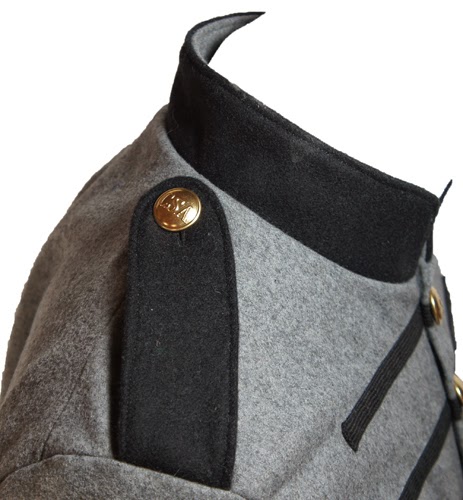
  • April – War & Peace: the extremes of conflict and long periods of peacetime both influence what people wear.  Make something that shows the effects of war, or of extended peace. (Daughter of the Regiment Reform dress -1860s- in the manner of the 1st Virginia Cavalry.)

  • May – Practicality:  Fancy party frocks are all very well, but everyone, even princesses, sometimes needs a practical garment that you can DO things in.  Create the jeans-and-T-Shirt-get-the-house-clean-and-garden-sorted outfit of your chosen period. (Gardening dress and smock, 1915, from the Sears Catalogue.)
  • June – Out of Your Comfort Zone: Create a garment from a time period you haven’t done before, or that uses a new skill or technique that you’ve never tried before. (Steam punk frock from Simplicity 2172)
  • July – Accessorize: The final touch of the right accessory creates the perfect period look.  Bring an outfit together by creating an accessory to go with your historical wardrobe. (Embroidered stockings from Kannik's Korner)
  • August – Heirlooms & Heritage: Re-create a garment one of your ancestors wore or would have worn, or use an heirloom sewing supply to create a new heirloom to pass down to the next generations. (My mother's Jackie Kennedy type wedding suit in ivory faille - bengalline)
  • September – Colour Challenge Brown: it’s not the most exciting colour by modern standards, but brown has been one of the most common, and popular, colours throughout history. Make something brown. (English smock-frock?)
  • October – Sewing Secrets: Hide something in your sewing, whether it is an almost invisible mend, a secret pocket, a false fastening or front, or a concealed message (such as a political or moral allegiance). (Pockets- early 18th C. Italian, embroidered)
  • November – Silver Screen: Be inspired by period fashions as shown onscreen (film or TV), and recreate your favourite historical costume as a historically accurate period piece. (Lilliie Langtry's LBD, half-scale, full-scale for self in lilac with ecru lace - black is not my colour!)
  • December – Re-Do:  It’s the last challenge of the year, so let’s keep things simple by re-doing any of the previous 11 challenges. (Accessorize - embroidered mitts, 185s-60s caps.)                
This in addition to business as usual and interpreting items, including full rig for Miss Lily Yeats for teaching in the schools (1900), and for the Pre-Raphaelite Salon (1840s-60s).


08 January 2015

The Way Forward


We have been quite busy here since Christmastide. It was our intention to take the Season, from the Solstice to Twelfth Night as a rest break to be with family and friends, but apart from the few days from the Solstice to Boxing Day, we have been working steadily on projects, making connections for future endeavours, and gathering together some new friends in out co-operative.

We put out a call for artisans, and overnight a coterie of half-a-dozen have responded thus far, with exuberance, willing and skillful hands and open hearts, sharing their stories and their beautiful selves with us.

Heart and hands together, we make a world that we can live in. This is the way forward. The Briarpatch lives!

Green blessings upon you all!
With deep Gratitude,
Kell, Owain,  Lord Byron bunny and the kitties, Ullyr and Siegfried


20 December 2014

Introduction to Morris' News from Nowhere

Attached is a wonderful conversation between Tony Pinkney of Lancaster University and the Reader as to why anyone should bother with a Utopian book from the 1890s. The book is free to read on the site, the William Morris Archive.

News From Nowhere Introduction

It begins thus:
Reader: Why should I be expected to read a description of an ideal society dating from the 1890s?  What can that possibly have to do with us today in the early twenty-first century?

TP: Well, do you think you already live in an ideal society, then, so that you don’t need any help or ideas from the past?  With a global economic crisis battering us all from 2008 onwards, with proliferating nuclear weaponry and dangerous international tensions, with the democratic hopefulness of the Arab Spring running into the sands, with international terrorism and the ‘war on terror’ mutually reinforcing each other, and with the environmental problems of climate change, energy depletion, habitat destruction and species extinction accelerating rather than slowing down, I’m inclined to think we need all the help we can get from the models of an ideal society that we inherit from the past!  We don’t have to swallow them hook, line and sinker, but there might be helpful suggestions and inspiration towards improvement there.

R: Well alright, things aren’t so good at the moment, I’ll concede that.  But if, like Morris in News from Nowhere, you have got a scheme for a good or even perfect society, why not set it out as a series of clear-cut propositions that we can debate straightforwardly?  Why present it in literary form instead?  Why turn it into a story?

TP: As it happens, Morris did set out clear-cut propositions for change in his political lectures of the 1880s.  When you’ve got time, take a look at ‘The Society of the Future’, which he first delivered in November 1887.  If you put your scheme into a story, though, you give greater concreteness to your abstract system; you can give a firsthand feel for how it works, you put flesh on its bare bones.  Instead of saying, as a sociology textbook might, the economy is organised in such and such a fashion, you can actually show people working together under the new social relations, show them in the very process of learning how to become new kinds of people (cooperative rather than competitive, say).  We as readers experientially participate in such new relationships, we feel them on our pulses, rather than just learning about them intellectually, as theoretical possibilities.

19 December 2014

DIY Hairpieces for the Lady Re-enactor, Part One

Some time ago, I purchased a cheap child's Rapunzel wig at Party City, as an alternative to more expensive hairpieces at Sally's or online. This was done for two reasons: ease of acquisition, and the fact that my natural haircolour is now a variegated sandy ginger blonde, which is very difficult to match.

The original wig was closer than anything else found, including the Sandy Blonde wefts at Sally's.
The first necessity was to tone down the unnatural blonde a bit. Into a pot with several dark Irish tea bags went the wig, soaking overnight. Then into a similar pot of dilute Manic Panic Atomic Turquoise conditioner, which is what I use to tone my hair around here. Easy, non-chemical, vegan. This was the resulting colour:

When the wig was dry, I combed it out with a shower comb and began to cut apart the wefts from the wig cap:


Don't be dismayed if you accidentally cut the weft, especially around the front edge.


When all the bottom wefts were off, I arranged then according to size:


The very top, I left whole as the basis for a fall of curls, as my primary hairstyle for Pre-Raphaelitism is 1870s:

The small wefts were then sewn together in pairs. they will be used for side curls, braids, and back curls, depending on need:

These will all go woven into my own hair, which, although hip length, still is not enough to make up the hairstyles of the 1820s-1900 to my satisfaction.  Some of this volume in the latter period may be created with pads and frizzing, but not the mass of curls of the earlier periods.

The switches were then braided loosely so as to avoid tangling, ready for the next part of the adventure, curl-papers and rags:


 As every reader of Victoriana knows, curling rags were used in the period, as an alternative to curling tongs (irons), which did not damage the hair. Some used curl papers instead, including Lord Byron and Beau Brummel.

More on which anon!

04 December 2014

The Arts and Crafts Ethic as a Template for the Future

We are embarking on a long-term project which significantly promotes the Arts and Crafts.

This project will delineate the origins of the ethic of the Arts and Crafts Movement of the late 19th and early 20th Centuries in America, the British Isles and selected countries in Europe. It will explicate the manner in which the ethic was lived by members of the movement, famous and obscure. It will trace the revivals of this ethic into modern times, including the Wandervogel in pre-World War II Germany and the Back to Nature movement of the 1970s. It will show the strong underpinning of this Movement in various contemporary social and artistic  movements across the world.
For the contemporary research, the project will include a website featuring surveys, a blog, and forum for discussion in community.

The result will be a published book on the findings, inspiring and leading people into a new, sane, sustainable future.

02 December 2014

Blue to the Elbow with Topsy

An idea becomes a search, which leads us back to our roots:
In thinking about some of the finer gauge items for ladies and children - lovely spencers and caracoes and other such jackets that don't want to be of a woolly pully weight as with Fair Isle - a possibility crept into my mind: lace-weight yarn (such as we use for Shetland shawls) in Fair Isle patterns!
I suspected that the result would be an entirely different animal than regular Fair Isle, and I was right - it is very dainty.


But how to achieve our colours in a reasonable price-point for people (Rowan yarns having a nice range of lace-weight colours but not extensive and at $13 a hank, makes the finished products very spendy.) Well, clearly, taking an ivory yarn and dyeing it. Just as Morris did to achieve his soft colours back in the day. Going back to our roots here of concocting plant-based dyes.

There are two options for the wool, a washing wool with nylon added, and pure merino. The two will dye similarly, but the washing wool will survive normal laundering at a warm temperature.


 As for the dyes, there is still the old option of bark, roots, leaves and berries, with the addition of mordants of alum, tin, copper and soon to achieve different shades.


But there are also now pre-mixed natural powder dyes in 48 beautiful colours, waiting to be blended. Mix water and powder, bring to a boil, add wool. No mordanting required.


I still do, however, think of Topsy at an important meeting, his arms blue to the elbow from an indigo dye vat.

25 November 2014

Artist's Tuesday- November

Locally, the first Tuesday of the month is free at all the museums in San Francisco. This is not the first Tuesday, but to inaugurate our Artist's Study Day, we went today to the Palace of the Legion of Honour to see the exhibit on Houghton Hall, built by Horace Walpole in the 1720s and handed down through the family to the present Marquess of Cholmondeley. It is one of the few stately homes in Britain still in use as a private home.


The highlights of the exhibit include the Salon
                                A view of the Saloon at Houghton Hall, Norfolk, England. Photo: Nick McCann

the Library
                                    Robert Walpole’s library at Houghton Hall, Norfolk, England. Photo: Nick McCann

several paintings by Hogarth, among which
            William Hogarth, The Cholmondeley Family, 1732. Oil on canvas, Marquess of Cholmondeley Houghton Hall

 and the gorgeous Chinese bed furnishings (hangings, coverlet and back drape) in the Cabinet
                                   Cabinet at Houghton Hall, Norfolk, England. Photo: Nick McCann
to which I stood nose to nose to examine the stitching, which was every bit as lovely as can be imagined. (Alas, no flash photography was permitted.)

There was a special surprise in seeing Burne-Jones' The Briar Wood live and up close.


I do break the rules and get close enough to the paintings to examine the technique, but I never ever touch objects in museums, no matter how much I might wish.

Withal, it was a very inspiring day!

02 November 2014

Commission Frock Coat- 12th Doctor Who

We are in the midst of making a toile for a commissioned 12th Doctor Who coat, for next year's ComiCon.

I was very pleased to find the perfect matches for the wool and lining
This is the pattern I am using, from Laughing Moon, Number 109, with some variations per the customer:
The changes are to the shoulder seam (he wants a modern one, rather than the period slanted one) and to the back vent (narrowed). For us it is a chance to have some fun doing men's tailoring at a couture level.

More photos upcoming as we move along in the process.

18 October 2014

Readying for Winter

At this time of year in the Northern Hemisphere, the weather can be changeable, with 'Indian Summer' - warm days and cold nights, hot one day and cold the next, snow, rain, or humidity all in one week in some areas. However, this is a perfect time to get one's house and wardrobe - and that of the family - ready for winter.


Mrs. Beeton, in her Book of Household Management says, 'In September and October it will be necessary to prepare for the cold weather, and get ready the winter clothing for the various members of the family. The white summer curtains will now be carefully put away, the fire-places, grates, and chimneys looked to, and the house put in a thorough state of repair.'

For our purposes, this is the time to rotate the linens, from summer cottons and coverlets to winter flannels and quilts. The former will want a wash, and the latter an airing, before being laid away in herbs to protect the beautiful starching from vermin, or to be laid upon the beds. Carefully examine the household linen, with a view to its being repaired, if necessary, before cleaning or airing.

Woolens likewise can be freshened, being well shaken and brushed, after being taken out of their pinning upon paper or linen, and camphor (to keep them from moths.) This is true for knitwear as well as cloth.

If your find that you are in need of knitwear or fashionable winter Artistic dress  now is the time to make them, or seeing to having items made, so to be ready for the first really cold days.

Sprucing up a pair of boots:
A lovely quilted winter bonnet:


Stylish Knitwear:


07 September 2014

Patterns and Pattern-Making


We have spent the day here at the exciting task of downloading a design programme, which allows us to share our new designs with you, showing various fabrics available, as well as making patterns for various sizes, cutting down on pattern drafting.

This is a very new thing for us, being used to the old method of sizing up patterns by the pivot and slide method, which is used in the pattern industry, and in which we were trained.

It may seem odd to be embracing new technology for such work, but even our dear Topsy had a jaquard loom for his designs, which enabled one man to do work which would have taken weeks in days; the loom was manually operated, thus did not violate the ethic of individual work.

Aside from enabling us to get to the fun work of making garments sooner, it also means that we can offer our lovely items as a line of sewing patterns for those interested in creating their own versions, with their own handmade embellishments.

Look in future for our patterns here and on Etsy!